


This article was automatically translated from the original Turkish version.
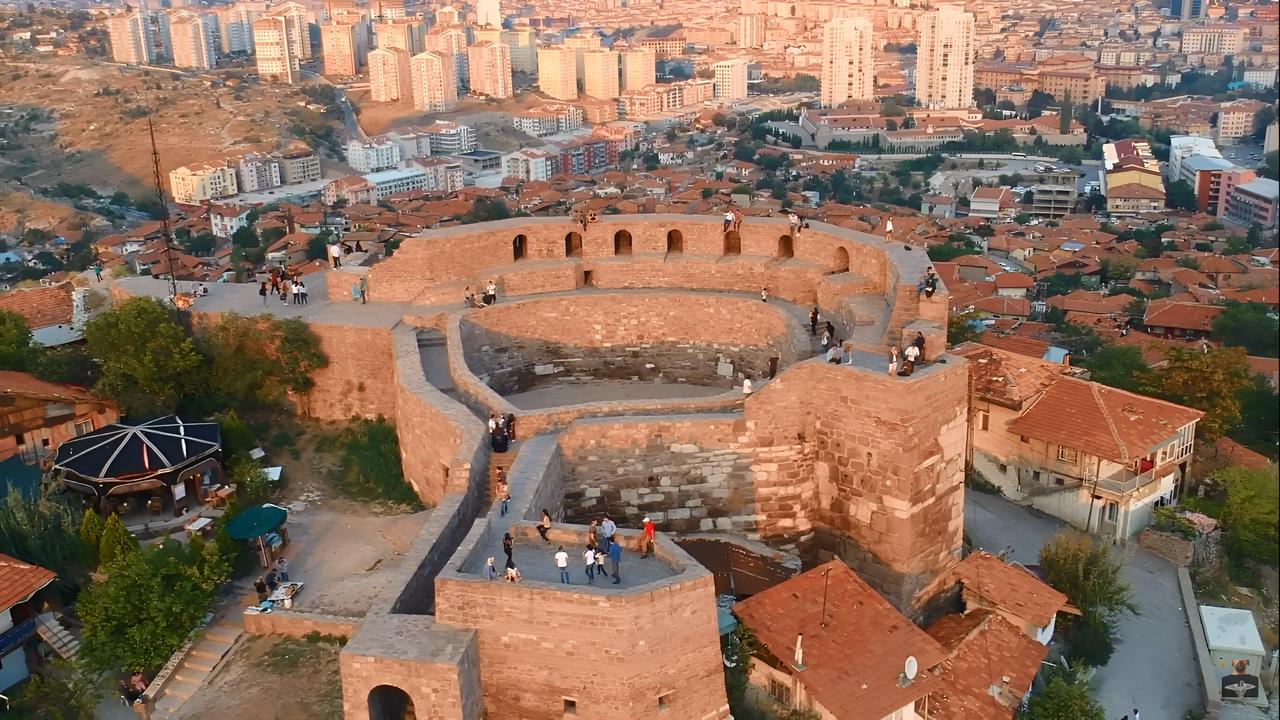
Ankara Castle
Location | Ankara A hill 110 meters above the Bent Deresi of Türkiye Hatip Çayı | ||||||||
|---|---|---|---|---|---|---|---|---|---|
Sections | Inner citadel and outer citadel | ||||||||
Inner Castle | An area of 43,000 m² with 42 pentagonal towers 14 to 16 meters high, built in four stories from Ankara stone and rubble stones | ||||||||
Outer Castle | Surrounds Ankara in a heart shape, with more than 20 towers, 350 meters north-south and 180 meters west-east | ||||||||
Gates | Outer Gate, Hisar Gate (with an Ilkhanid inscription) | ||||||||
Material | Marble Basalt (bottom) Brick (top) Rubble stones collected from Roman monuments | ||||||||
Ankara Castle is one of the symbols of Türkiye’s capital Ankara and has a history as old as the city itself. Castle has been used for defense and settlement purposes throughout history due to its strategic location and has been repaired and expanded by different civilizations. This structure, consisting of two main sections—the inner and outer castle—is located in the center of Ankara, on a hill 110 meters above the Bent Deresi stream of Hatip Çayı.
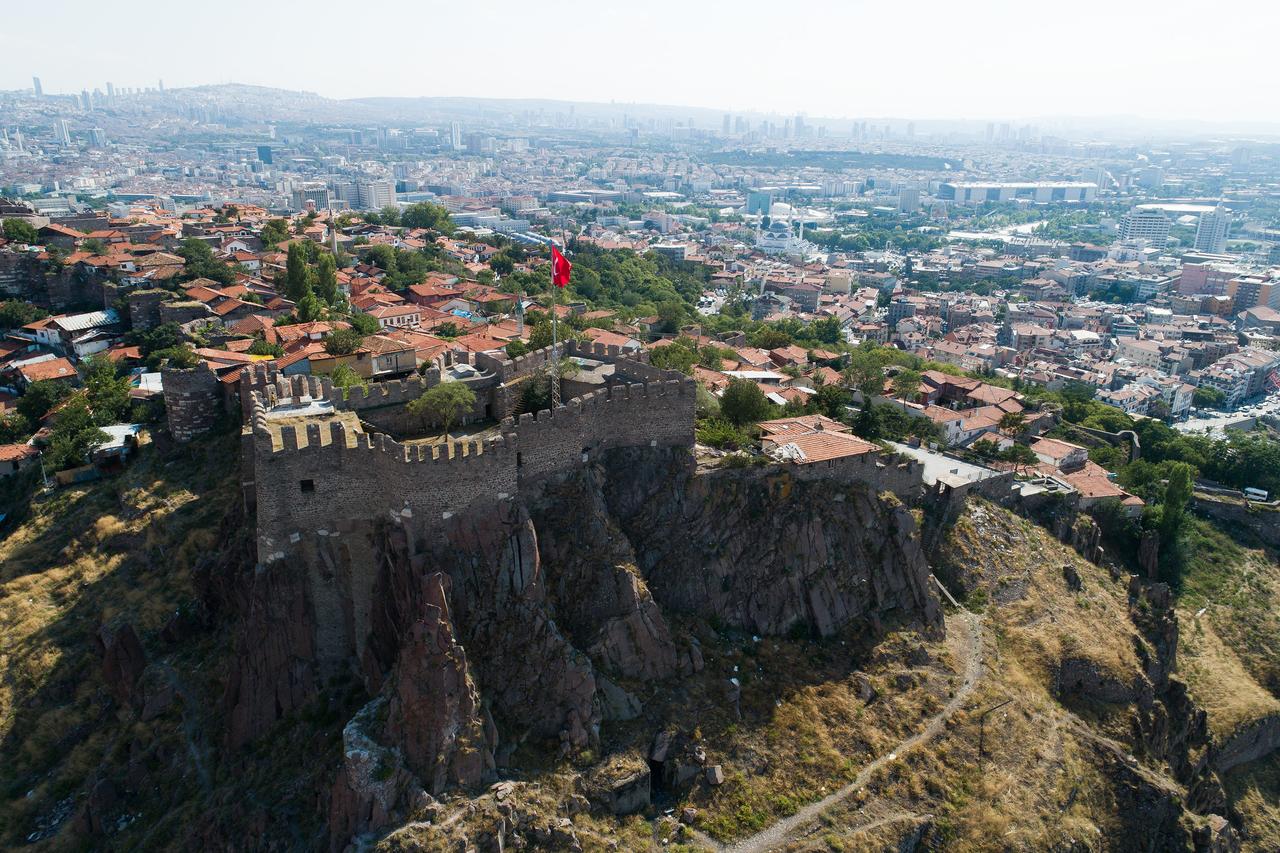
Ankara Kalesi (AA)
The exact construction date of Ankara Castle is unknown. Although it is believed to have been built during the period when the Hittites maintained a military garrison in the city, this view has not been confirmed by archaeological evidence. By the 2nd century BCE, when the Galatians settled in Ankara, the castle was already known to exist. During the Roman period, its walls were repaired by Emperor Caracalla in 217 CE, but at that time the castle walls were located lower than today’s, around the Augustus Temple. Between 222 and 260 CE, the castle was partially destroyed following Emperor Severus Alexander’s defeat by the Persians and the capture of Emperor Valerianus. From the second half of the 7th century, the Romans began restoring it. Emperor Constantine built the outer castle in 688, and Emperor Leo IV repaired the castle walls in 740, raising the inner ramparts. Emperors Nikephoros and Basil I also carried out repairs in the 9th century.
During the Byzantine period, the castle was strengthened by the construction of inner walls in the 7th century but suffered damage from attacks and was restored again in the 9th century. Two years after the Battle of Manzikert, in 1073, the Seljuks gained control of the region, repaired and expanded the castle. Sultan I. Alaeddin Keykubad restored the castle, and II. Kaykavus added extensions in 1249. The castle was briefly captured in 1101 by Crusader commander Raymond, but returned to the Seljuks in 1227, leaving an inscription documenting Seljuk repairs on its northwestern section. During the Ottoman period, the castle did not undergo major restoration, but in 1832, Ibrahim Pasha, son of the Egyptian governor Mehmet Ali Pasha, restored its walls. In these repairs, marble blocks, column capitals, and water channel troughs collected from Roman monuments were used as building materials.
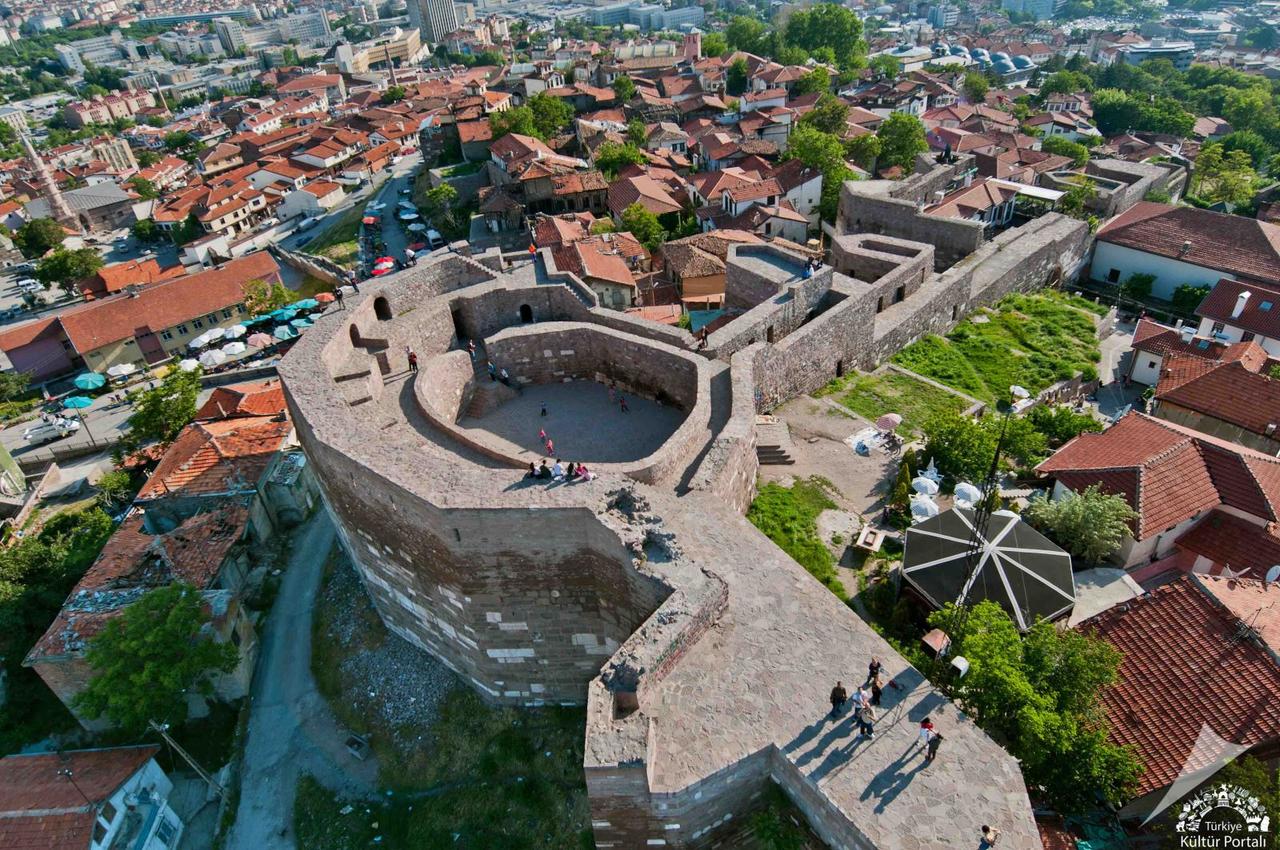
Ankara Kalesi (Kültür Portalı)
Ankara Castle consists of two sections: the inner and outer castle. The outer castle encircles the old city of Ankara in a heart-like shape and extends approximately 350 meters north-south and 180 meters west-east, featuring more than 20 towers. The inner castle covers an area of 43,000 square meters and has 42 mostly pentagonal towers with heights ranging from 14 to 16 meters. The inner castle is four stories high and constructed partly from Ankara stone and partly from rubble stone; the lower sections are made of marble and basalt, while the upper sections are built of brick. The inner castle has two main gates: the Outer Gate and the Hisar Gate. An inscription from the Ilkhanid period is located above the Hisar Gate. The highest point of the castle is Akkale in the southeast corner (known among the public as Alitaşı).
The walls reflect construction techniques from different periods: the lower courses are Roman, while the upper sections belong to the Byzantine, Seljuk, and Ottoman eras. The saw-tooth-shaped towers and the tax inscription above the Hisar Gate dedicated to Ilkhanid ruler Abu Sa'id Bahadur Khan are among the castle’s notable features. Additionally, a clock tower built for the French in 1885 is located to the left of the Hisar Gate.
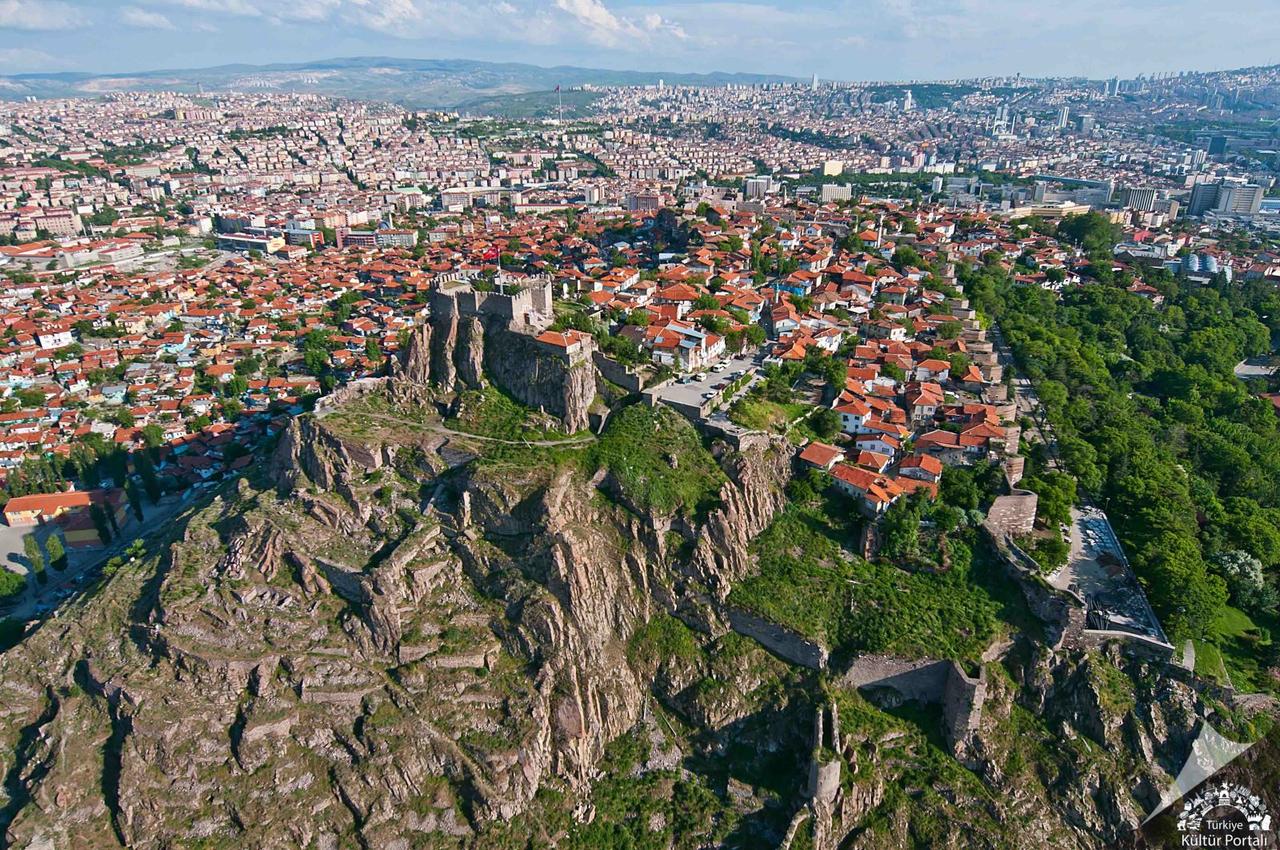
Ankara Kalesi (Kültür Portalı)
Within the castle, numerous traditional Ankara houses from the Ottoman period remain. These houses in the Kaleiçi neighborhood were built two or three stories high using wood, adobe, and brick on narrow and uneven terrain. The lower floors, with thick walls and small windows, were designed for winter use, while the upper floors, with thinner walls and better ventilation, were intended for summer use. Wide eaves, overhanging balconies, and “cihannüma” summer rooms are distinctive features of these homes. Geometric decorations are prominent on wooden ceilings. Today, some of these houses serve as restaurants, shops, or museums.
The squares within the castle (Atpazarı, Samanpazarı, Koyunpazarı) have served as centers of trade and gathering throughout history and continue to do so today. Within the inner castle are Ankara’s oldest mosque, Alaaddin Camii (built during the period of Mesut bin Kılıçarslan), Ramazan Şemsettin, Müsafir Fakih, Dev Duran, and Cenab-ı Ahmet mosques. In the outer castle are mosques reflecting the Ahi tradition: Arslanhane (Ahi Şerafettin), Ahi Elvan, and Ahi Yakup mosques. Additionally, commercial and lodging structures such as Çengelhan, Çukurhan, Kurşunlu Han, Pilavoğlu Han, and Safran Han lie within the castle boundaries; Çengelhan and Safran Han now house the Rahmi Koç Museum, while Kurşunlu Han serves as the Museum of Anatolian Civilizations.
17th-century traveler Evliya Çelebi described Ankara Castle as a “strong castle built of four tiers of white stone on the summit of a high mountain.” He noted that the inner castle was surrounded by cliffs, making ascent difficult, and that it contained artillery, ammunition, and 600 houses. The castle was enclosed by three tiers of walls, with the outer walls securing the entire city.
Today, Ankara Castle attracts visitors due to its historical significance and the city views it offers. The Eti Museum, established in Akkale in 1921 under Atatürk’s guidance, became the first museum of the Republic and operated until 1948. Although the castle contains secret passages and gates built for defense, these are now sealed. This structure, bearing witness to Ankara’s past, also draws attention for its neighborhood culture and architectural heritage.
Altındağ Belediyesi. "Ankara Kalesi." Accessed April 4, 2025.http://www.altindag.gov.tr/ankara--kalesi
Anadolu Ajansı. “Tarih, Kültür ve Ticaret Merkezi: Ankara Kalesi.” Accessed April 4, 2025.https://www.aa.com.tr/tr/kultur-sanat/tarih-kultur-ve-ticaret-merkezi-ankara-kalesi/1228905
Ankara Kalesi. “Başkent Ankara’nın Tarihçesi.” Accessed April 4, 2025.https://www.ankarakalesi.com/kopyas%C4%B1-ba%C5%9Fkent-ankara-n%C4%B1n-tarih%C3%A7esi.
Ankara Valiliği. “Ankara Kalesi.” Accessed April 4, 2025.http://www.ankara.gov.tr/ankara-kalesi
Culture Portal. "Ankara Kalesi | Kültür Portalı." Accessed April 4, 2025.https://www.kulturportali.gov.tr/turkiye/ankara/gezilecekyer/ankara-kalesi

Ankara Castle
Location | Ankara A hill 110 meters above the Bent Deresi of Türkiye Hatip Çayı | ||||||||
|---|---|---|---|---|---|---|---|---|---|
Sections | Inner citadel and outer citadel | ||||||||
Inner Castle | An area of 43,000 m² with 42 pentagonal towers 14 to 16 meters high, built in four stories from Ankara stone and rubble stones | ||||||||
Outer Castle | Surrounds Ankara in a heart shape, with more than 20 towers, 350 meters north-south and 180 meters west-east | ||||||||
Gates | Outer Gate, Hisar Gate (with an Ilkhanid inscription) | ||||||||
Material | Marble Basalt (bottom) Brick (top) Rubble stones collected from Roman monuments | ||||||||
History
Structural Features
Life and Architecture Within the Castle
Historical Testimonies and the Present