


This article was automatically translated from the original Turkish version.
+2 More
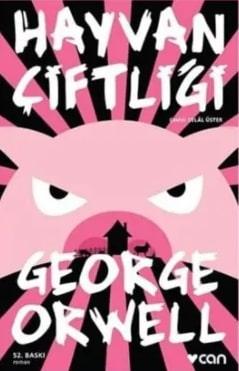
Animal Farm (Book)
Author(s) | George Orwell | ||||||||
|---|---|---|---|---|---|---|---|---|---|
Original Title | Animal Farm | ||||||||
Publication Year | 1945 | ||||||||
Type(s) | Allegorical novel political satire | ||||||||
Subject(s) | Critique of totalitarian regime corruption of power | ||||||||
Language(s) | English (original) translated into many languages | ||||||||
First Turkish Translation | Halide Edib Adıvar (1954) | ||||||||
Animal Farm is a political satire novel written by British author author George Orwell as an allegorical critique of the Soviet Union and the Stalinist regime. The story begins with the animals on Manor Farm rising up against human domination and taking control of the farm to govern themselves. Although they initially strive to establish an ideal system of equality, the pigs gradually seize power and establish a dictatorship more oppressive than the one they overthrew.
The elderly pig Great Old Major inspires the animals to rebel against their human oppressors and encourages them to fight for freedom. He dies shortly after delivering his speech, and the pigs Snowball and Napoleon lead a revolution to seize control of the farm. A new ideology called “Animalism” is developed, and seven commandments are established:
Over time, Napoleon drives out his rival Snowball and consolidates all power. The pigs begin to resemble humans, acquire privileges, and violate the original rules. Eventually, the seven commandments are erased and replaced by a single rule: "All animals are equal, but some animals are more equal than others."
The novel uses allegory to explore the following themes:
Orwell uses this novel to allegorically depict events following the 1917 Russian Revolution. The events on the farm mirror the power struggles that occurred in the Soviet Union after the revolution. Napoleon’s seizure of power parallels Stalin’s expulsion of Trotsky. The worsening living conditions of the animals after the revolution reflect the hardships endured by workers and peasants under Stalin’s rule.
Animal Farm faced censorship upon publication and was heavily criticized by circles supportive of the Soviet Union. During the Cold War era, the book was also regarded in the West world as an anti-communist work. Nevertheless, some interpretations have argued that the novel also highlights the flaws of the capitalist system.
Today, Animal Farm remains one of the most frequently studied works in courses on politics, literature, and history.
"Animal Farm – George Orwell." *Türk Edebiyatı*. Accessed March 2025. https://www.turkedebiyati.org/hayvan-ciftligi-george-orwell/.
"Animal Farm." *Kitap Diyarı*. Accessed March 2025. https://kitapdiyari.com.tr/politika-siyaset/hayvan-ciftligi/.
"Animal Farm." *Kitap Yazarokur*. Accessed March 2025. https://kitap.yazarokur.com/hayvan-ciftligi.
"Animal Farm: About the Novel and Summary – George Orwell." *Literature and Arts Academy*. Accessed March 2025. https://edebiyatvesanatakademisi.com/post/hayvan-ciftligi-romani-hakkinda-ve-ozeti-george-orwel/84269.
Altıparmak, İpek Beyza, and Abdullah Durakoğlu. "‘Hayvan Çiftliği’ Adlı Eseri Bağlamında George Orwell’ın Tarihi ve Sosyolojik Tespitlerini Değerlendirmek." *Manas Sosyal Araştırmalar Dergisi* 10, no. 3 (2021): 1910–1922. Accessed March 2025. https://dergipark.org.tr/tr/download/article-file/1549397.
George Orwell’s View of the Capitalist System: Animal Farm. Fırat Üniversitesi Gazetesi. Accessed March 2025. https://gazete.firat.edu.tr/george-orwellin-kapitalist-sisteme-bakisi-hayvan-ciftligi.html.

Animal Farm (Book)
Author(s) | George Orwell | ||||||||
|---|---|---|---|---|---|---|---|---|---|
Original Title | Animal Farm | ||||||||
Publication Year | 1945 | ||||||||
Type(s) | Allegorical novel political satire | ||||||||
Subject(s) | Critique of totalitarian regime corruption of power | ||||||||
Language(s) | English (original) translated into many languages | ||||||||
First Turkish Translation | Halide Edib Adıvar (1954) | ||||||||
Subject and Summary
Themes and Allegorical Meaning
Characters
Historical and Sociological Context
Criticism and Impact