This article was automatically translated from the original Turkish version.
Kingdom | Sitta krueperi | ||||||||
|---|---|---|---|---|---|---|---|---|---|
Family | Sittidae | ||||||||
Order | Passeriformes | ||||||||
Class | Aves | ||||||||
Division | Chordata | ||||||||
Realm | Animalia | ||||||||
Genus | Sitta | ||||||||
Conservation Status | Least Concern (LC) | ||||||||
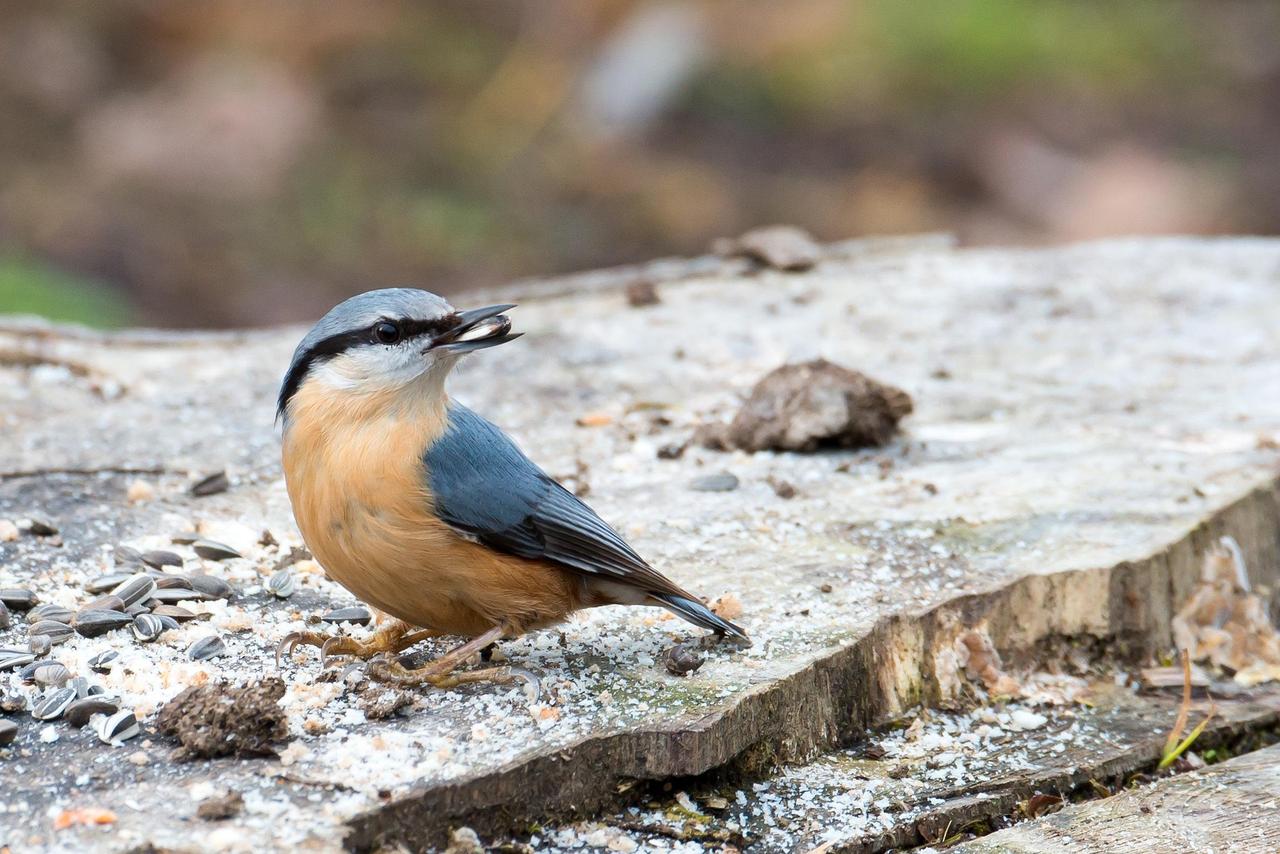
Anatolian Nuthatch (Sitta krueperi), is an endemic songbird species found only in Anatolia, southern Caucasus, southwestern Russia, and the Greek island of Lesvos. It is recognized by its medium size, short bill, and strong climbing ability.
Its distribution is largely restricted to pine and other coniferous forests. Its diet consists of insects, spiders, and conifer seeds depending on the season; it is a resident species but exhibits seasonal altitudinal movements. It is classified by the International Union for Conservation of Nature as “Least Concern”.
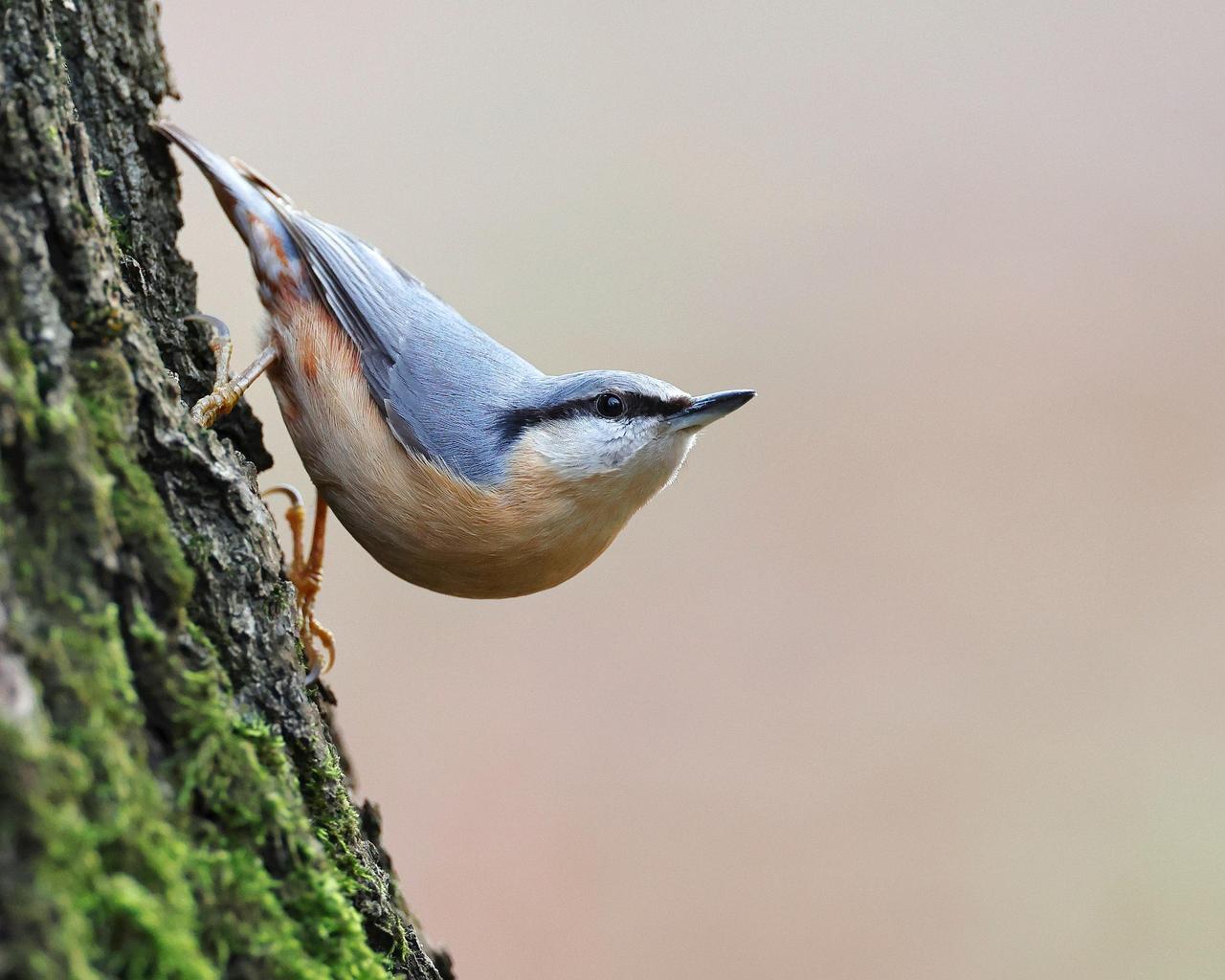
Anatolian Nuthatch (pixabay)
The Anatolian Nuthatch is a medium-sized nuthatch measuring approximately 12–13 cm in length and weighing 10–14 g. The male has a bright black and blue-shimmering forehead; from this area a white eyebrow stripe extends backward toward the nape. A distinct black line runs through the eye level. The back, wing coverts, and tail feathers are bluish-gray; the flight feathers are darker with pale bluish-gray edges.
The side tail feathers have bluish-gray and white tips. The cheeks, throat, and sides of the neck are white. A distinctive reddish-brown patch appears at the center of the breast; the flanks and belly transition to gray, while the lower belly and undertail coverts are dirty white to brownish. The undertail coverts are chestnut with whitish tips. The bill is dark horn-colored with a gray-blue base; the eyes are dark chestnut or brown, surrounded by a thin white ring. The legs are dark gray or brownish.
Females resemble males but the black on the forehead is duller and less defined toward the rear; the breast patch is paler, more orange-red. Juveniles lack the black forehead; the upperparts are dull, the breast patch is pale and indistinct. The bill is dark horn-colored, the lower mandible base is pinkish, and the gape is yellow.
The Anatolian Nuthatch is a regionally endemic species with a restricted geographic range. It occurs throughout much of Turkey, especially in the western, southern, and northern Anatolian mountain ranges; only on the island of Lesvos in Greece; and in southwestern Russia (Krasnodar region and northwestern Caucasus) and northern Georgia.
Its habitat is primarily confined to coniferous forests. In Turkey it inhabits lowland forests of Aleppo pine (Pinus brutia); at higher elevations it lives in fir (Abies), spruce (Picea), black pine (Pinus nigra), cedar (Cedrus libani), and occasionally juniper (Juniperus) stands. On Lesvos it is dependent on Aleppo pine but may nest in broadleaf trees if they are nearby. In the Caucasus it extensively uses fir and spruce forests, mixed beech–fir (Fagus–Abies) communities, and occasionally scattered maple (Acer) groves.
Altitudinal distribution varies by region. In Turkey it is mostly found between 500–1000 m, locally near sea level and up to 1700 m in Uludağ and 2500 m in the Taurus Mountains. On Lesvos it ranges from 200–700 m, descending to sea level in winter. In the Caucasus it occurs between 1000–2000 m, though it has been recorded as low as 150 m along the Black Sea coast.
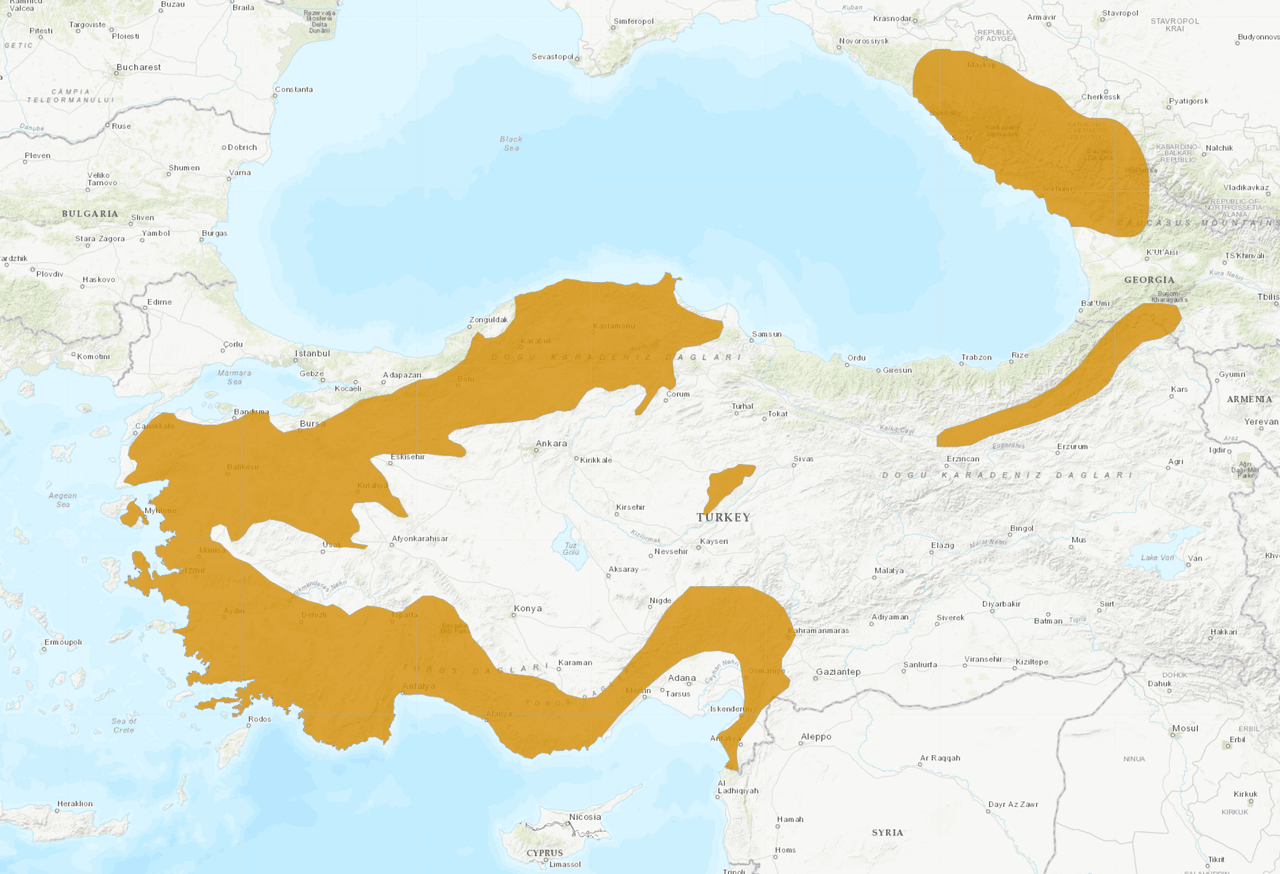
Distribution Map (IUCN Red List)
The diet of the Anatolian Nuthatch varies seasonally. During the breeding season its primary food consists of insects, larvae, and spiders; chicks are fed exclusively animal matter. In autumn and winter, seeds of coniferous trees—especially Aleppo pine (Pinus brutia) and other pine, fir, and spruce species—become the main food source.
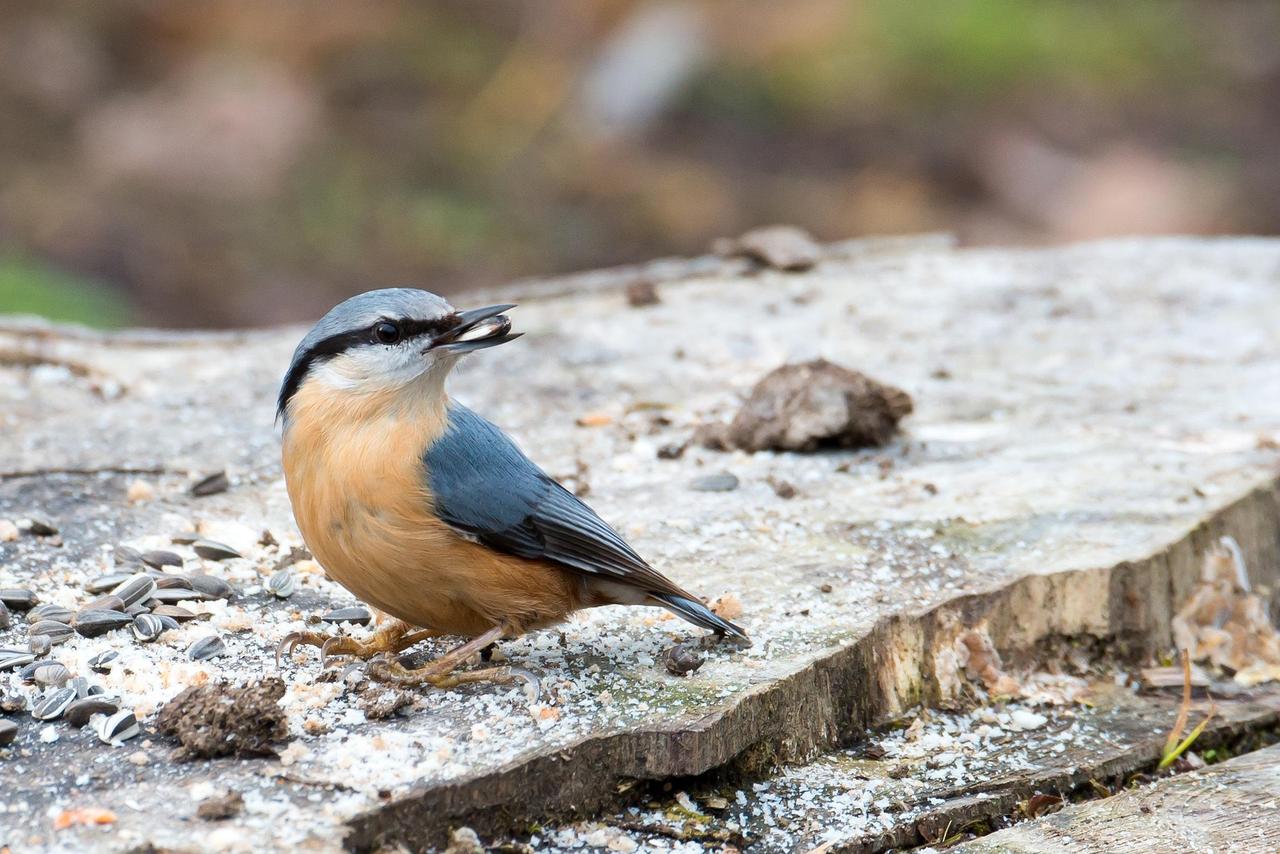
Anatolian Nuthatch (pixabay)
While foraging, it is typically active on thin branches, cones, and trunks of trees. It inserts the tip of its bill between cone scales to extract seeds, then wedges them into crevices in bark or hidden cracks for storage. These food caches serve as a vital food source during rainy and cold periods when cones remain closed. Occasionally it forages on the ground and rarely catches insects in flight. Outside the breeding season it feeds alone or in small groups and may join mixed-species flocks in winter.
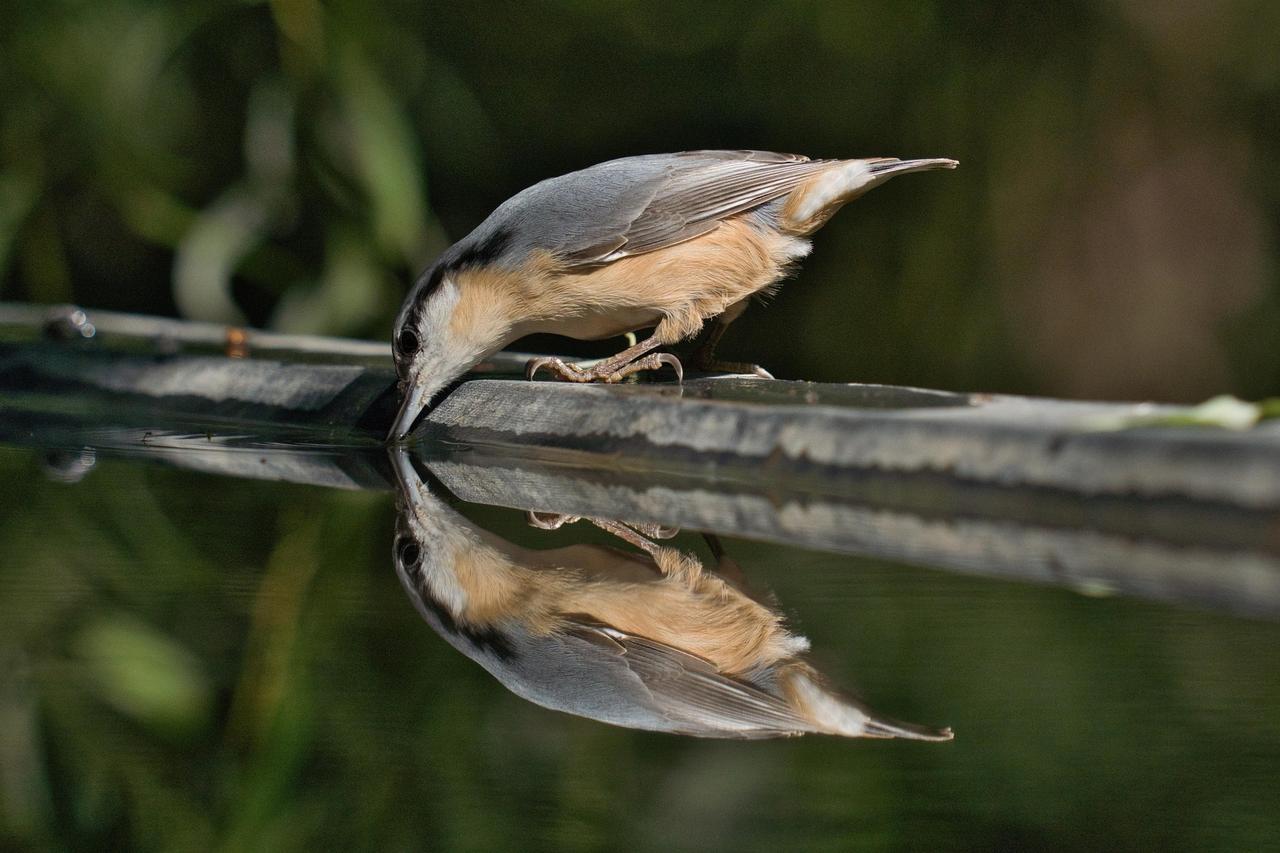
Anatolian Nuthatch (pixabay)
The breeding season of the Anatolian Nuthatch begins between mid-April and mid-May, depending on region and elevation. The species is monogamous and pairs exhibit strong territorial behavior around the nest site. Nests are typically located in cavities in the trunks or thick branches of coniferous trees; occasionally the female cleans or enlarges an existing cavity, and rarely excavates a new one. The nest base is lined with coarse bark fragments, cone scales, and decayed wood, while the interior is lined with moss, fibers, feathers, and hairs.
The female lays 5–7 eggs, which have a dirty white background marked with reddish or purplish spots. Incubation is performed solely by the female and lasts approximately 14–17 days. During this period the male occasionally feeds the female. Chicks are fed by the female with her bill until fledging, after which they are fed by both parents with insects and spiders. The fledging period ranges from 16 to 22 days.
Nest site selection is largely restricted to old coniferous trees; therefore, the felling of dead trees or the destruction of cavity-bearing trees directly impacts breeding success.
The Anatolian Nuthatch is a highly vocal species. In alarm or agitation it emits sharp, hissing-like short calls such as “cha” or “sharr”; these calls accelerate into a rapid, rattling series as excitement increases. During flight a nasal, short “cek” call is common. Softer contact calls include “pwit” and sparrow-like “dui” or “doid” sounds.
Its song can be heard year-round but is most intense in spring. The typical song is a sharp, undulating trill lasting 4–8 seconds, delivered at a rate of about eight repetitions per second, perceived as “pip-pip-pip…” or “vit-vit-vit…”. In more complex forms it exhibits a high-pitched, echoing double-note pattern such as “yu-di, yu-di…” or “vika-vika…”. Songs are primarily used during territorial defense or mate attraction.
Anatolian Nuthatch Song (xeno-canto)
The Anatolian Nuthatch (Sitta krueperi) is classified by the International Union for Conservation of Nature (IUCN) as “Least Concern” globally. Its total population is estimated at 120,000–450,000 pairs, the majority of which reside in Türkiye. A small but stable population exists on the Greek island of Lesvos, while populations in the Caucasus and Russia are smaller and more irregular.
Between 1990 and 2000, the largest populations in Türkiye and Russia declined by more than 20%, and this decline continued in Türkiye from 2000 to 2012. The population on Lesvos remained relatively stable. Major threats include increasing tourism and summer construction along coastal areas, degradation of old coniferous forests, felling of large trees for resin production, and forest fires. In the Caucasus, the cutting of old fir and spruce forests directly affects breeding habitats.
The species is listed on Appendix I of the European Union Birds Directive and Appendix II of the Bern Convention. It is classified as a threatened species in the Red Data Books of Türkiye and Greece. Conservation measures should prioritize maintaining the continuity of old coniferous forests, protecting dead trees in forest management, and limiting habitat loss due to tourism.
Albayrak, Tamer, and Erdoğan, Ali. “Distribution, density, and important hotspots of Krüper’s Nuthatch Sitta krueperi in Turkey and Lesvos Island, Greece”. *Turkish Journal of Zoology* 42, no. 5 (2018): 578–584. Accessed September 25, 2025.https://journals.tubitak.gov.tr/zoology/vol42/iss5/6/
BirdLife International. “Krueper's Nuthatch *Sitta krueperi*.” *The IUCN Red List of Threatened Species* 2024. Accessed September 25, 2025.https://dx.doi.org/10.2305/IUCN.UK.2024-2.RLTS.T22711184A264592216.en.
Caswi. “Kuş, Ornitoloji, Sitta avrupa görseli JPG.” Pixabay. Accessed September 25, 2025.https://pixabay.com/tr/photos/ku%C5%9F-ornitoloji-sitta-avrupa-8252511/.
Harrap, S. and C. J. Sharpe. “Krüper's Nuthatch (Sitta krueperi), version 1.0. In Birds of the World (J. del Hoyo, A. Elliott, J. Sargatal, D. A. Christie, and E. de Juana, Editors).” Cornell Lab of Ornithology, Ithaca, NY, USA, 2020. Accessed September 25, 2025.https://birdsoftheworld.org/bow/species/krunut1/1.0/introduction
Linjama, Tero. “XC348192 · Krüper's Nuthatch · *Sitta krueperi*.” *xeno-canto.* Accessed September 25, 2025.https://xeno-canto.org/348192.
Sharkolot. “Kuş, Avrasya sıvacı kuşu, Hayvan görseli JPG.” Pixabay. Accessed September 25, 2025.https://pixabay.com/tr/photos/ku%C5%9F-avrasya-s%C4%B1vac%C4%B1-ku%C5%9Fu-hayvan-7723465/.
Wolfgangvogt_lb. “Sıvacı kuşu, Sitta avrupa, Doğa görseli JPG.” Pixabay. Accessed September 25, 2025.https://pixabay.com/tr/photos/s%C4%B1vac%C4%B1-ku%C5%9Fu-sitta-avrupa-ku%C5%9F-2103464/.

Kingdom | Sitta krueperi | ||||||||
|---|---|---|---|---|---|---|---|---|---|
Family | Sittidae | ||||||||
Order | Passeriformes | ||||||||
Class | Aves | ||||||||
Division | Chordata | ||||||||
Realm | Animalia | ||||||||
Genus | Sitta | ||||||||
Conservation Status | Least Concern (LC) | ||||||||
No Discussion Added Yet
Start discussion for "Anatolian Siskin (Sitta krueperi)" article
Morphological Characteristics
Distribution and Habitat
Diet
Breeding
Vocalizations and Song
Conservation Status