


This article was automatically translated from the original Turkish version.
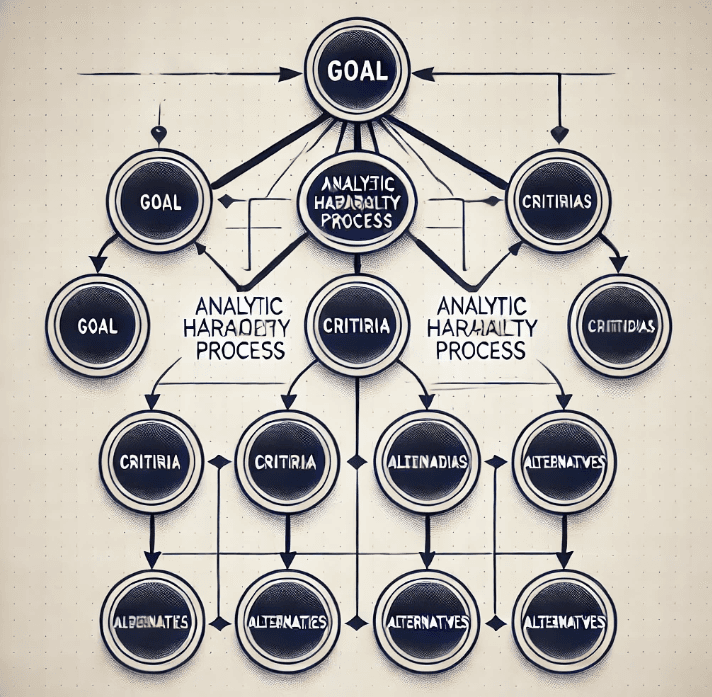
Description | The Analytic Hierarchy Process (AHP) method is a hierarchical model used in multi-criteria decision making processes. The figure illustrates the structuring of a decision problem using the AHP method. At the top level is the 'Goal' at the second level are the 'Criteria' and at the third level are the 'Alternatives'. Decision makers determine weights by making pairwise comparisons between criteria and alternatives and identify the most suitable option. This systematic approach helps solve complex decision problems in a more consistent and objective manner. | ||||||||
|---|---|---|---|---|---|---|---|---|---|
Analytic Hierarchy The Analytic Hierarchy Process (AHP) is a method developed to solve multi-criteria decision making problems. It was first introduced by Thomas L. Saaty in the 1970s. AHP helps quantify comparisons between criteria and alternatives by transforming complex decision processes into a hierarchical structure. This method is particularly preferred in decision problems based on uncertainty or subjective judgments.
The AHP method is based on three fundamental principles:
Hierarchical Structuring: Organizing the problem into a hierarchy consisting of the goal, criteria, subcriteria, and alternatives.
Pairwise Comparisons: Determining priority weights through pairwise comparisons between criteria and alternatives.
Consistency Analysis: Calculating the consistency ratio (CR) to evaluate the consistency of the decision maker’s comparisons.
The following steps are followed to apply the AHP method:
The decision problem is transformed into a hierarchical structure comprising the goal, criteria, and alternatives. For example, assuming a company needs to select the best supplier, the hierarchy might look like this:
Goal: Select the best supplier
Criteria: Price, quality, delivery time, service quality
Alternatives: Supplier A, Supplier B, Supplier C
Decision makers create comparison matrices by performing pairwise comparisons for each criterion and alternative. Preference intensities are determined using Saaty’s 1–9 scale:
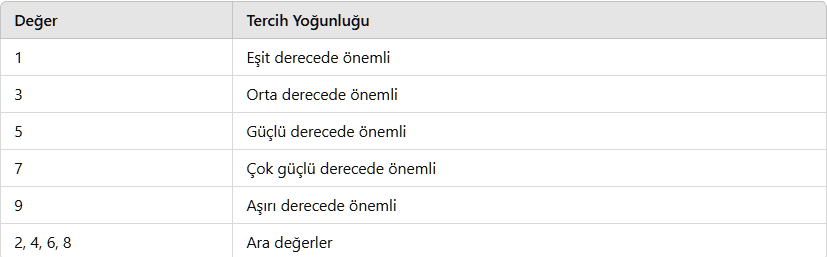
For example, if the criterion “Price” is considered three times more important than “Quality,” the comparison matrix will assign (Price, Quality) = 3 and (Quality, Price) = 1/3.
Criterion weights are calculated using the eigenvector method or the average weight method from the comparison matrix. The same process is repeated for alternatives to determine their priority values.
The consistency ratio (CR) is calculated to assess the consistency of comparisons. A CR value less than 0.10 indicates that the judgments are consistent. If CR > 0.10, the comparisons must be reviewed.
The consistency ratio is calculated using the following formula:
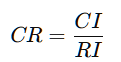
Where:
CI: Consistency Index
RI: Random Index (obtained from tables)
The weights calculated for criteria and alternatives are combined to derive the final ranking of alternatives. The alternative with the highest overall weight is the decision maker’s optimal choice.
The AHP method has a wide range of applications. Some common application areas include:
Business and Management: Supplier selection, investment decisions, risk analysis
Engineering and Industry: Product design, production planning
Healthcare: Hospital management, selection of treatment methods
Public Administration and Urban Planning: Politics determination, infrastructure projects
Education: University preferences, academic performance evaluations
AHP provides decision makers with a systematic and analytical frame to help them make more informed and consistent decisions.
Alp, S., & Gündoğdu, C. E. (2013). Kuruluş yeri seçiminde analitik hiyerarşi prosesi ve bulanık analitik hiyerarşi prosesi uygulaması. Dokuz Eylül Üniversitesi Sosyal Bilimler Enstitüsü Dergisi, 15(2), 173-186.
Cengiz, T., & Çelem, H. (2003). Kırsal kalkınmada analitik hiyerarşi süreci (AHS) yönteminin kullanımı. Artvin Çoruh Üniversitesi Orman Fakültesi Dergisi, 4(1-2), 45-55.
Timor, M. (2011). Analitik Hiyerarşi Prosesi. İstanbul: Türkmen Kitabevi.
Yılmaz, İ. (2010). Analitik Hiyerarşi Prosesi (AHP) ve Coğrafi Bilgi Sistemleri (CBS) ile Eskişehir İli potansiyel erozyon alanlarının belirlenmesi. 73. Türkiye Jeoloji Kurultayı Bildiriler Kitabı, 1, 345-356.
Önder, G., & Önder, E. (2015). Analitik hiyerarşi süreci. In G. Önder & E. Önder (Ed.), Çok Kriterli Karar Verme Yöntemleri (pp. 102-120). Bursa: Dora Yayıncılık.

Description | The Analytic Hierarchy Process (AHP) method is a hierarchical model used in multi-criteria decision making processes. The figure illustrates the structuring of a decision problem using the AHP method. At the top level is the 'Goal' at the second level are the 'Criteria' and at the third level are the 'Alternatives'. Decision makers determine weights by making pairwise comparisons between criteria and alternatives and identify the most suitable option. This systematic approach helps solve complex decision problems in a more consistent and objective manner. | ||||||||
|---|---|---|---|---|---|---|---|---|---|
No Discussion Added Yet
Start discussion for "Analytic Hierarchy Process (AHP)" article
Basic Principles of AHP
Steps of AHP
Modeling the Problem Hierarchically
Constructing Pairwise Comparison Matrices
Calculating Weights and Priorities
Performing Consistency Analysis
Comparing Alternatives and Reaching the Final Decision
Advantages and Disadvantages of AHP
Advantages
Disadvantages
Application Areas of AHP