


The Amaterasu particle, detected on May 27, 2021, by the Telescope Array (TA) observatory located in the state of Utah, United States, is the second most energetic cosmic ray particle ever recorded. It is named after Amaterasu, the sun goddess in Japanese mythology. The detected energy level was 244 exa-electronvolts (EeV), which is millions of times greater than the energy produced by human-made particle accelerators.
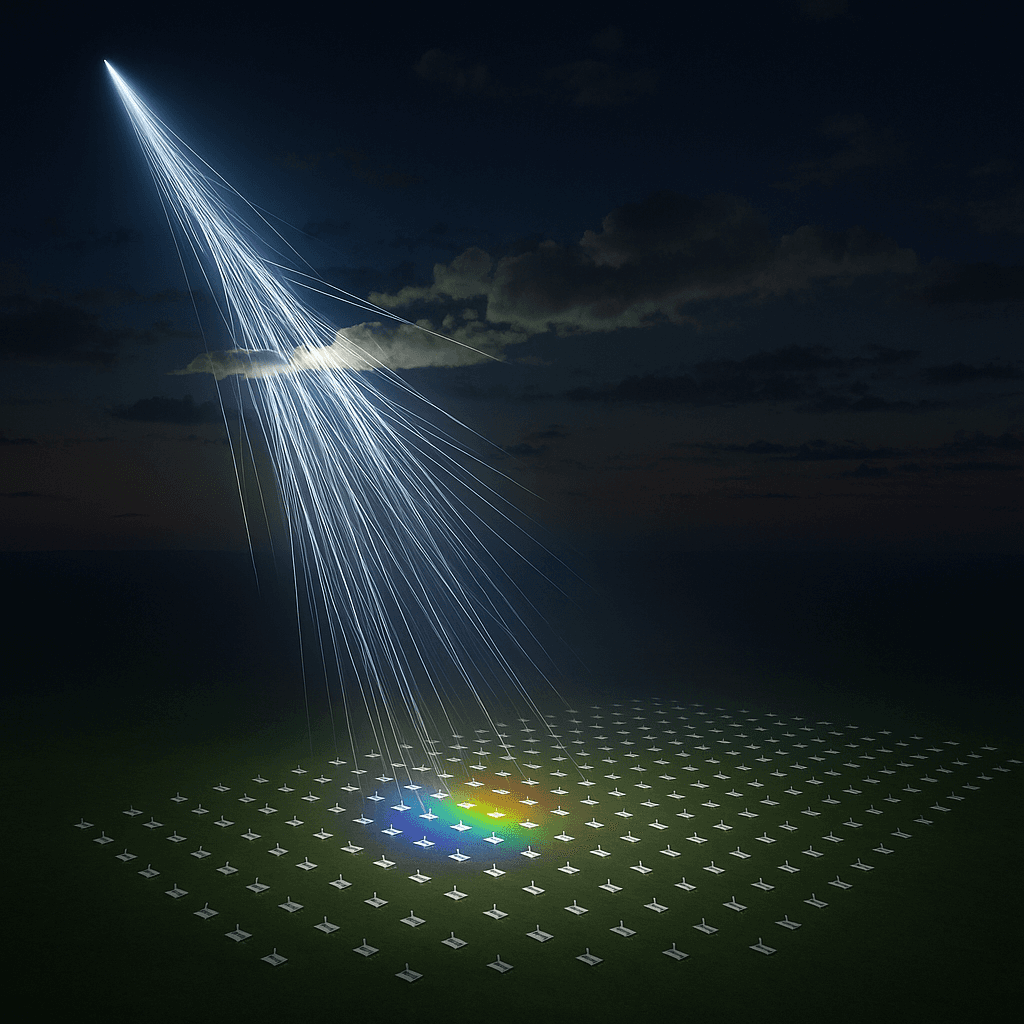
An Image of the Telescope Array Observatory Where the Amaterasu Particle Was Detected (AI-Generated)
The Telescope Array is a system composed of 507 surface detectors spread over an area of 700 km². The Amaterasu particle triggered 23 of these detectors, creating an interaction over approximately 48 km². The particle's energy was measured at 2.4 × 10²⁰ eV, making it the second-highest energy level ever recorded after the “Oh-My-God” particle detected in 1991.
Amaterasu Particle: An Ultra-High-Energy Cosmic Ray from the Voi (Dave Darling)
The direction from which the Amaterasu particle arrived points toward a largely matterless region of space located at the edge of the Milky Way Galaxy, known as the "Local Void." This region contains no known high-energy astrophysical sources, which has led to various speculations regarding the particle's origin.
The extraordinary energy and unknown origin of the Amaterasu particle have prompted scientists to develop several theoretical explanations:
The discovery of the Amaterasu particle challenges current understanding of the origin and nature of ultra-high-energy cosmic rays. It has opened new avenues of research into how such particles can reach extreme energy levels and how they are guided through intergalactic magnetic fields.
Amaterasu Particle (AI-Generated)
Unger, Michael, and Glennys R. Farrar. "Where Did the Amaterasu Particle Come From?" arXiv preprint arXiv:2312.13273 (2023). Accessed May 14, 2025. https://www.researchgate.net/publication/377905088_Where_Did_the_Amaterasu_Particle_Come_From
Sarmah, Prantik, et al. "Constraining the superheavy dark matter origin of ultrahigh-energy cosmic rays with the Amaterasu event." arXiv preprint arXiv:2406.03174 (2024). Accessed May 14, 2025. https://www.researchgate.net/publication/391258131_Constraining_the_superheavy_dark_matter_origin_of_ultrahigh-energy_cosmic_rays_with_the_Amaterasu_event
Bourriche, Nadine, and Francesca Capel. "Beyond the Local Void: A Comprehensive View on the Origins of the Amaterasu Particle." arXiv preprint arXiv:2406.16483 (2024). Accessed May 14, 2025. https://www.researchgate.net/publication/390064024_Beyond_the_Local_Void_A_comprehensive_view_on_the_origins_of_the_Amaterasu_particle
Frampton, Paul H., and Thomas W. Kephart. "The Amaterasu Cosmic Ray as a Magnetic Monopole and Implications for Extensions of the Standard Model." arXiv preprint arXiv:2403.12322 (2024). Accessed May 14, 2025. https://www.researchgate.net/publication/381236878_The_Amaterasu_Cosmic_Ray_as_a_Magnetic_Monopole_and_Implications_for_Extensions_of_the_Standard_Model
EurekAlert. "Amaterasu Particle: A New Cosmic Mystery." Accessed May 14, 2025. https://www.eurekalert.org/news-releases/1008434.
The University Of UTAH. "Telescope Array Detects Second Highest-Energy Cosmic Ray Ever." Accessed May 14, 2025. https://attheu.utah.edu/facultystaff/cosmic-ray-2023/
The Guardion. "What the Heck is Going On? Extremely High-Energy Particle Detected Falling to Earth." Accessed May 14, 2025. https://www.theguardian.com/science/2023/nov/24/amaterasu-extremely-high-energy-particle-detected-falling-to-earth.
Dave Darling. "The Amaterasu particle: ultra-high-energy cosmic ray from the void." Accessed May 14, 2025. https://www.youtube.com/watch?v=KHQ7aREkQyI.

Detection and Characteristics
Origin and Trajectory
Possible Sources and Theories
Scientific Significance
This article was created with the support of artificial intelligence.