This article was automatically translated from the original Turkish version.
Original Name(s) | Almond | ||||||||
|---|---|---|---|---|---|---|---|---|---|
Type(s) | Novel | ||||||||
Author(s) | Won-pyung Sohn | ||||||||
Translator(s) | Tayfun Kartav | ||||||||
Publication Year | 2021 | ||||||||
First Publication Date(s) | 2017 | ||||||||
Publisher(s) | Peta Kitap | ||||||||
Number of Pages | 256 | ||||||||
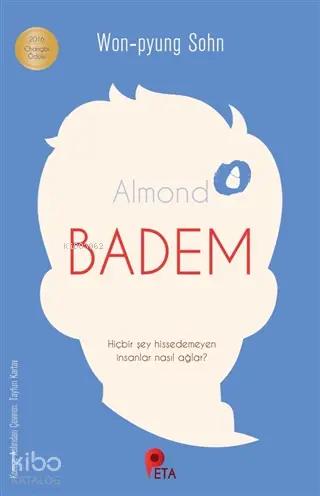
Badem is a novel written and directed by South Korean author and filmmaker Won-pyung Sohn, first published in its original language in 2017. The work explores alexithymia, a condition described in medical literature as "emotional deafness" or "emotional blindness," through a fictional narrative grounded in neurological difference. Classified within the young adult category of Korean literature, this is the author’s debut novel. The Turkish translation was done by Tayfun Kartav and published in 2020.
The novel centers on Yunjae, a young person whose amygdala—the almond-shaped region of the brain—has failed to develop from birth, rendering him unable to experience fundamental emotions such as fear, anger, or joy. Yunjae lives with his mother and grandmother. To ensure he does not draw attention and appears "normal" in society, his mother subjects him to an education based on memorizing emotional responses. Hoping to stimulate the growth of his amygdala, his mother feeds him almonds at every meal. The turning point in the narrative occurs on Yunjae’s sixteenth birthday, which coincides with Christmas Eve. A socially marginalized aggressor attacks Yunjae’s family in front of his eyes, resulting in the death of his grandmother and his mother falling into a vegetative state with severe injuries. Despite this tragedy, Yunjae, due to his physiological condition, shows no emotional response and is consequently accused of emotional detachment, leading him to begin a solitary life. The story follows Yunjae’s journey of growth through his relationships with Gon and Dora, characters he meets while running a secondhand bookshop.
The language of the novel is plain and unadorned, consistent with the narrator Yunjae’s cognitive condition. Written from a first-person singular perspective, the narrator, unable to interpret emotions, presents events through objective, metaphor-free observation. This style, dominated by short sentences, is deliberately chosen to reflect the emptiness within the character’s inner world.
Aulia, Prima Danti, and Marudut Bernadtua Simanjuntak. "Moral Value of Novel 'Almond' Written By Shon Won Pyung." PUSTAKA: Jurnal Bahasa dan Pendidikan 2, no. 1 (2022): 1-11. Accessed November 22, 2025.
Kartav, Tayfun, and Hatice Köroğlu Türközü. "Koreli Yazar Sohn Won-Pyung’un Badem Romanı Üzerine Bir İnceleme." World Language Studies 5, no. 1 (2025): 91–120. Accessed November 22, 2025.
Sohn, Won-pyung. Badem. Translated by Tayfun Kartav. Istanbul: Peta Kitap, 2020.
Thomas, Blessy Anna. "Through the Looking Glass: Reading Almond and Demian through an Intertextual Queer Lens." Teresian Journal of English Studies 15, no. 4 (2023): 77-88. Accessed November 22, 2025. https://tjes.teresas.ac.in/grezocup/2024/01/October-%E2%80%93-December-2023-Volume-15-Issue-4.pdf#page=76
[1]
Tayfun Kartav ve Hatice Köroğlu Türközü, "Koreli Yazar Sohn Won-Pyung’un Badem Romanı Üzerine Bir İnceleme," World Language Studies 5, sy. 1 (2025): 93. https://dergipark.org.tr/en/download/article-file/4621237
[2]
Tayfun Kartav ve Hatice Köroğlu Türközü, "Koreli Yazar Sohn Won-Pyung’un Badem Romanı Üzerine Bir İnceleme," World Language Studies 5, sy. 1 (2025): 93. https://dergipark.org.tr/en/download/article-file/4621237

Original Name(s) | Almond | ||||||||
|---|---|---|---|---|---|---|---|---|---|
Type(s) | Novel | ||||||||
Author(s) | Won-pyung Sohn | ||||||||
Translator(s) | Tayfun Kartav | ||||||||
Publication Year | 2021 | ||||||||
First Publication Date(s) | 2017 | ||||||||
Publisher(s) | Peta Kitap | ||||||||
Number of Pages | 256 | ||||||||
No Discussion Added Yet
Start discussion for "Almond; How Do People Who Feel Nothing Cry? (Book)" article
Plot Summary
Themes
Characters
Writing Style
Awards and Achievements