This article was automatically translated from the original Turkish version.
Name(s) | Ataş Church (Greek Church) / Aktaş Church Mosque | ||||||||
|---|---|---|---|---|---|---|---|---|---|
Location | Niğde / Türkiye | ||||||||
Construction Date(s) | According to oral tradition 1842 | ||||||||
Plan Type | Three-aisled, vaulted basilica plan | ||||||||
Original Function | Greek Orthodox Church | ||||||||
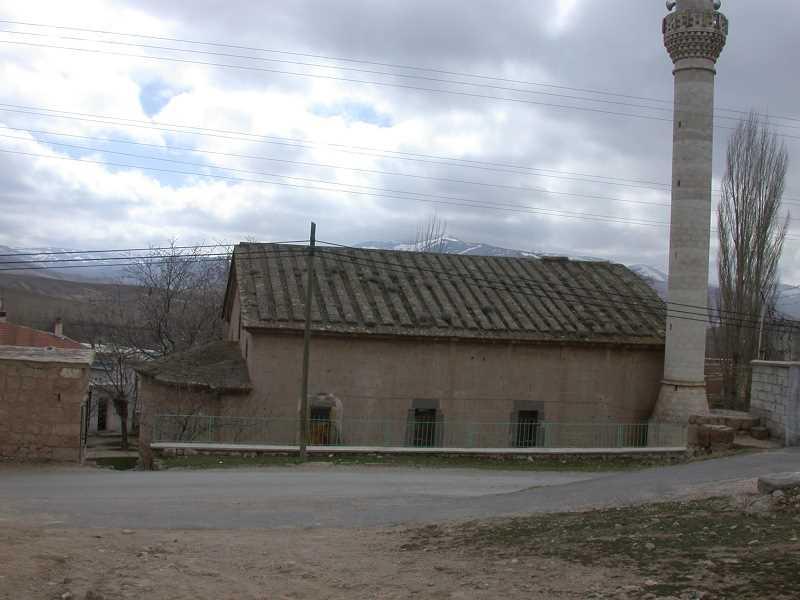
Aktaş Church is a three-aisled basilica with barrel-vaulted ceilings, built in 1842 according to local tradition, located in the center of Niğde. A minaret was added to its northwest corner, and the narthex, which was demolished in the 1950s, was replaced by a new congregational space, converting the building into a mosque.

Aktaş Church (Türkiye Culture Portal)
The church has a three-aisled basilical plan oriented east-west, covered by barrel vaults. A minaret was later added to the northwest corner. The interior space is plastered. The structure combines yellowish trachyte stone with basalt stone as building materials.
The narthex of the building was demolished in the 1950s and replaced by a new congregational area. Some architectural elements from this section, including columns and capitals, still remain in the vicinity of the structure.

Aktaş Church Architectural Plan (Türkiye Culture Portal)
The iconostasis in the naos remains in its original position. Additionally, within the prothesis section of the iconostasis, glass lighting elements bearing cross motifs have been preserved. These original lighting components are significant details reflecting the building’s religious function.
The ablution fountain in the church’s courtyard contains small stone capitals used as seating units. These capitals are likely from the gynekaion, the section of the building designated for women. It is also believed that the large capitals and columns found in the courtyard were originally part of the narthex.
Aktaş Church, which previously served both as a church and a mosque, is now preserved following restoration. It is regarded as one of the important examples of late Ottoman Christian architecture in Niğde, due to its architectural elements, decorations, and original structural components.
Ministry of Culture and Tourism of the Republic of Türkiye. "AKTAŞ KİLİSE CAMİİ (Rum Kilisesi)." Niğde İl Kültür veTurizm Müdürlüğü. Accessed June 22, 2025. https://nigde.ktb.gov.tr/Eklenti/51045,aktas-rum-kilisesipdf.pdf?0
T.C. Ministry of Culture and Tourism. "Kilise ve Şapeller." *Niğde İl Kültür veTurizm Müdürlüğü. Accessed June 22, 2025. https://nigde.ktb.gov.tr/TR-154659/kilise-ve-sapeller.html
T.C. Ministry of Culture and Tourism. “Aktaş Kilise Camii (Rum Kilisesi) – Niğde.” *Türkiye Kültür Portalı*. Accessed June 22, 2025. https://kulturportali.gov.tr/turkiye/nigde/kulturenvanteri/aktas-klse-cam-rum-kilisesi

Name(s) | Ataş Church (Greek Church) / Aktaş Church Mosque | ||||||||
|---|---|---|---|---|---|---|---|---|---|
Location | Niğde / Türkiye | ||||||||
Construction Date(s) | According to oral tradition 1842 | ||||||||
Plan Type | Three-aisled, vaulted basilica plan | ||||||||
Original Function | Greek Orthodox Church | ||||||||
No Discussion Added Yet
Start discussion for "Aktaş Church Mosque" article
Architectural Features
Courtyard and Ablution Fountain Elements
Current Condition