This article was automatically translated from the original Turkish version.
Period(s) | İlhanlı Dönemi | ||||||||
|---|---|---|---|---|---|---|---|---|---|
Construction Date(s) | 1314 | ||||||||
Founder(s) | Ali oğlu Ahmed bin Yusuf | ||||||||
Location | Erzurum | ||||||||
Courtyard | Kapalı | ||||||||
Building Type | Medrese | ||||||||
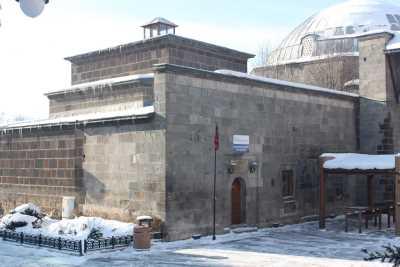
Ahmediye Medresesi is a historical structure located in Erzurum, at Erzincan Gate, in Murat Paşa Neighborhood, east of Murat Paşa Camii. Above the entrance door of the medrese, there is a three-line inscription. According to the inscription, the medrese was built in 1314 by Gani Ahmed bin Ali bin Yusuf.
Ahmediye Medresesi was constructed during the Ilkhanid period. The inscription on the building indicates that it was built by Gani Ahmed bin Ali bin Yusuf in either 714 AH–1314 CE or 724 AH–1323 CE. The medrese was used for many years as a storage facility and suffered damage. It was restored and its surroundings were landscaped between 1986 and 1988, and again repaired in 2005–2006 by the General Directorate of Foundations. The structure was placed under protection by the High Council for Immovable Historical Monuments on 13 November 1976 under decision no. A-188.
The medrese was built on a closed courtyard plan with two iwan halls, single story and without revak. Access is provided through a door in the northeast corner room. In the center of the building is a closed courtyard covered by a mirrored cross vault. On the south and north facades of the courtyard are two iwan halls, each measuring 4.30 x 3.85 meters and closed with pointed barrel vaults. The northern iwan serves as the entrance iwan, while the southern iwan is the main iwan, featuring a mihrap in its rear wall.
On the east and west sides of the courtyard are two small cells each. At each of the four corners of the building are symmetrical large rooms covered by vaults. The capitals of the columns at the corners of the iwans and the geometric motifs found in various parts of the structure serve as decorative elements. Within the geometric patterns of the mihrap, eight-pointed stars are present. The structure was built entirely using cut stone. The original minaret was constructed of brick but collapsed during a storm in 1928. The lead marks visible on the walls date back to the periods when Armenians occupied Erzurum.【1】
The medrese has a rectangular plan. Two medrese rooms are located along each side of the courtyard. The presence of a mihrap in the iwan opposite the courtyard indicates that the building was used as a mosque. The mihrap visible on the north facade suggests that a mosque previously existed at this location.【2】
T.C. Ministry of Culture and Tourism. "Medreseler." Erzurum Kültür veTurizm İl Müdürlüğü. Accessed March 6, 2026. https://erzurum.ktb.gov.tr/TR-56082/medreseler.html
Tokgöz, Leyla. “Ahmediye Medresesi.” Türkiye Turizm Ansiklopedisi. Accessed March 6, 2026. https://turkiyeturizmansiklopedisi.com/ahmediye-medresesi
Türkiye Kültür Portalı. "Ahmediye Medresesi - Erzurum." T.C. Kültür ve Turizm Bakanlığı. Accessed March 6, 2026. https://www.kulturportali.gov.tr/turkiye/erzurum/gezilecekyer/ahmediye-medresesi
[1]
Leyla Tokgöz, ''Ahmediye Medresesi,'' Türkiye Turizm Ansiklopedisi, Erişim 6 Mart 2026, https://turkiyeturizmansiklopedisi.com/ahmediye-medresesi
[2]
Türkiye Kültür Portalı, “Ahmediye Medresesi - Erzurum,” T.C. Kültür ve Turizm Bakanlığı, Erişim 6 Mart 2026, https://www.kulturportali.gov.tr/turkiye/erzurum/gezilecekyer/ahmediye-medresesi

Period(s) | İlhanlı Dönemi | ||||||||
|---|---|---|---|---|---|---|---|---|---|
Construction Date(s) | 1314 | ||||||||
Founder(s) | Ali oğlu Ahmed bin Yusuf | ||||||||
Location | Erzurum | ||||||||
Courtyard | Kapalı | ||||||||
Building Type | Medrese | ||||||||
No Discussion Added Yet
Start discussion for "Ahmediye Medresesi (Erzurum)" article
History
Architectural Features
Plan