badge icon

This article was automatically translated from the original Turkish version.

Article

Adversarial Generator Network (GAN)

Quote

Generative Adversarial Networks (GANs) are a model developed in 2014 by Ian Goodfellow and colleagues that revolutionized the field of deep learning. GANs operate through a structure in which two opposing neural networks learn by working birlikte. One of these networks is called the generator, and the other is called the discriminator. The primary goal of GANs is to enable the generator to produce data that resembles gerçek data, while the discriminator learns to determine whether the data is sahte or genuine.

Working Principle

GANs function through a mutual training process between the two networks. These networks engage in a kind of adversarial oyun as they train each other. Initially, the generator produces random data, and the discriminator evaluates whether this data appears realistic. The generator strives to produce data so realistic that it can deceive the discriminator, while the discriminator is trained to better distinguish between real data and fake data.


  • Generator: It attempts to generate data samples resembling real data, starting from random noise. Initially, the generated data is not realistic, but over the course of training it produces increasingly higher quality and more realistic outputs.
  • Discriminator: It tries to distinguish between real data and fake data generated by the generator. Initially, its predictions may be random, but over time it gains the ability to more accurately differentiate between real and fake data.


The training process enables both networks to improve through mutual feedback. This continuous adversarial competition allows the generator to produce more realistic data and the discriminator to become better at detecting fake data olanak. Ultimately, GANs can generate highly realistic and high-quality data over time.
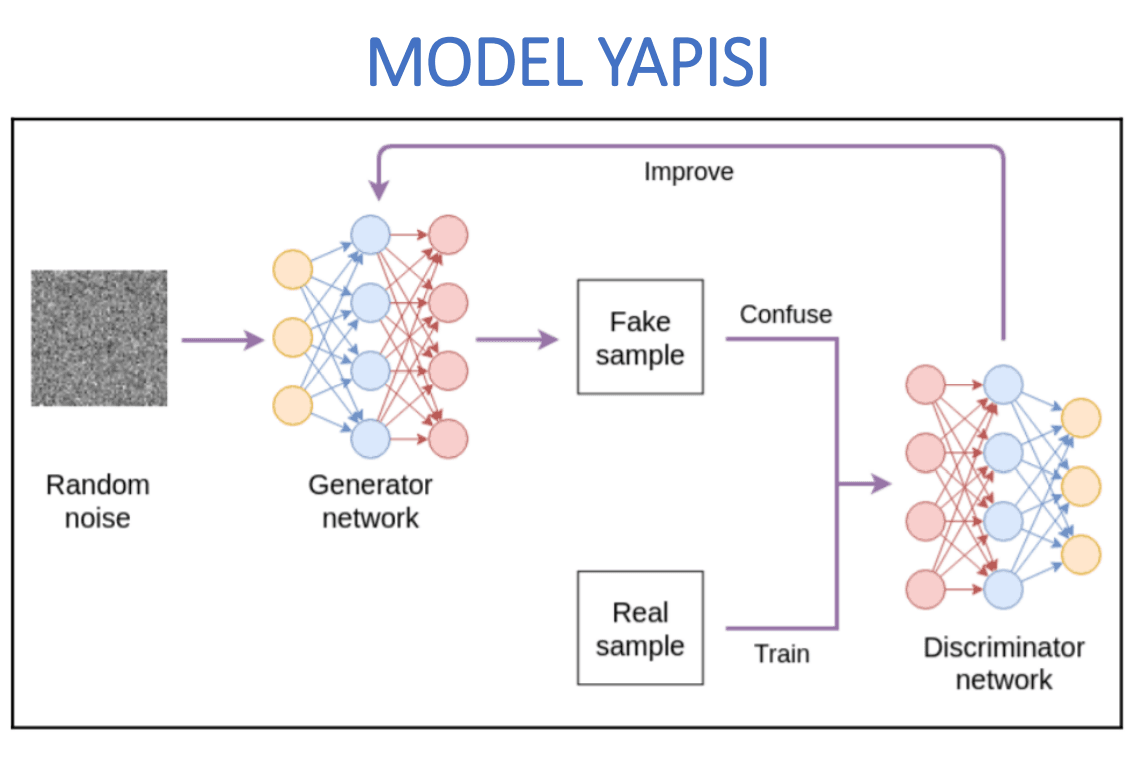

GAN Model Structure (Credit: Oğuzhan Gündüz)

Application Areas

GANs have found a wide range of applications in the fields of deep learning and artificial intelligence. These include:


  • Image Generation: GANs are used to generate realistic human faces, landscapes, and other visual content. They are particularly prominent in DeepFake technologies.
  • Image Enhancement: GANs can be used to upscale low-resolution images to high resolution.
  • Art and Design: GANs are employed in creative fields to generate new artworks and stylized images.
  • Data Augmentation: GANs are used to generate missing examples in datasets to increase data diversity.
  • Text and Audio Generation: GANs can generate not only images but also other types of data such as text and audio. Examples include text-based content generation and voice response systems.


Network Types

GANs come in various types, each customized for specific applications. The most yaygın GAN types are as follows:

  • Vanilla GAN: The most basic GAN model, using simple architectures for both generator and discriminator.
  • Conditional GAN (cGAN): Trained with specific labels or information. For example, generating an image labeled as a “rose”.
  • CycleGAN: Used to perform transformations between two different domains. For example, changing the style of an image to resemble a different art style.
  • Deep Convolutional GAN (DCGAN): Uses deep convolutional neural networks to generate high-resolution images.
  • Self-Attention GAN (SAGAN): Incorporates self-attention mechanisms to examine image details more carefully.


Advantages

  • High Creativity: GANs can generate data that has never existed before and does not occur in the real world.
  • Data Diversity: GANs enhance data diversity by generating missing or underrepresented examples within datasets.
  • Learning Capacity: GANs are flexible networks capable of modeling data across a wide range of applications.


Challenges and Limitations

  • Training Difficulties: Training GANs often leads to imbalances and instabilities. If the generator becomes too strong, the discriminator may become ineffective.
  • Evaluation Metrics: It is difficult to measure whether generated data is truly realistic. Therefore, appropriate evaluation metrics for GANs must be developed.
  • Computational Cost: Training GANs requires significant computational power, especially when using large datasets.


Generative Adversarial Networks (GANs) represent an important discovery in the fields of artificial intelligence and deep learning, with great potential in generative modeling and veri generation. GANs are widely used as a powerful arac across many domains, from image generation to text creation, and will continue to evolve and open new application areas as technology advances.

Bibliographies

Amazon Web Services. "What is GAN (Generative Adversarial Network)?" Amazon Web Services (AWS).Accessed adresi.

TechTarget. "Generative Adversarial Network (GAN)." TechTarget.Accessed adresi.

Yapay Zeka TR. "Generative Adversarial Networks (GAN) Nedir?" YouTube, April 20, 2020.Accessed adresi.

Author Information

Avatar
AuthorYağmur Nur KüçükarslanJuly 21, 2026 at 5:30 PM

Discussions

No Discussion Added Yet

Start discussion for "Adversarial Generator Network (GAN)" article

View Discussions

Contents

  • Working Principle

  • Application Areas

  • Network Types

  • Advantages

  • Challenges and Limitations