


This article was automatically translated from the original Turkish version.
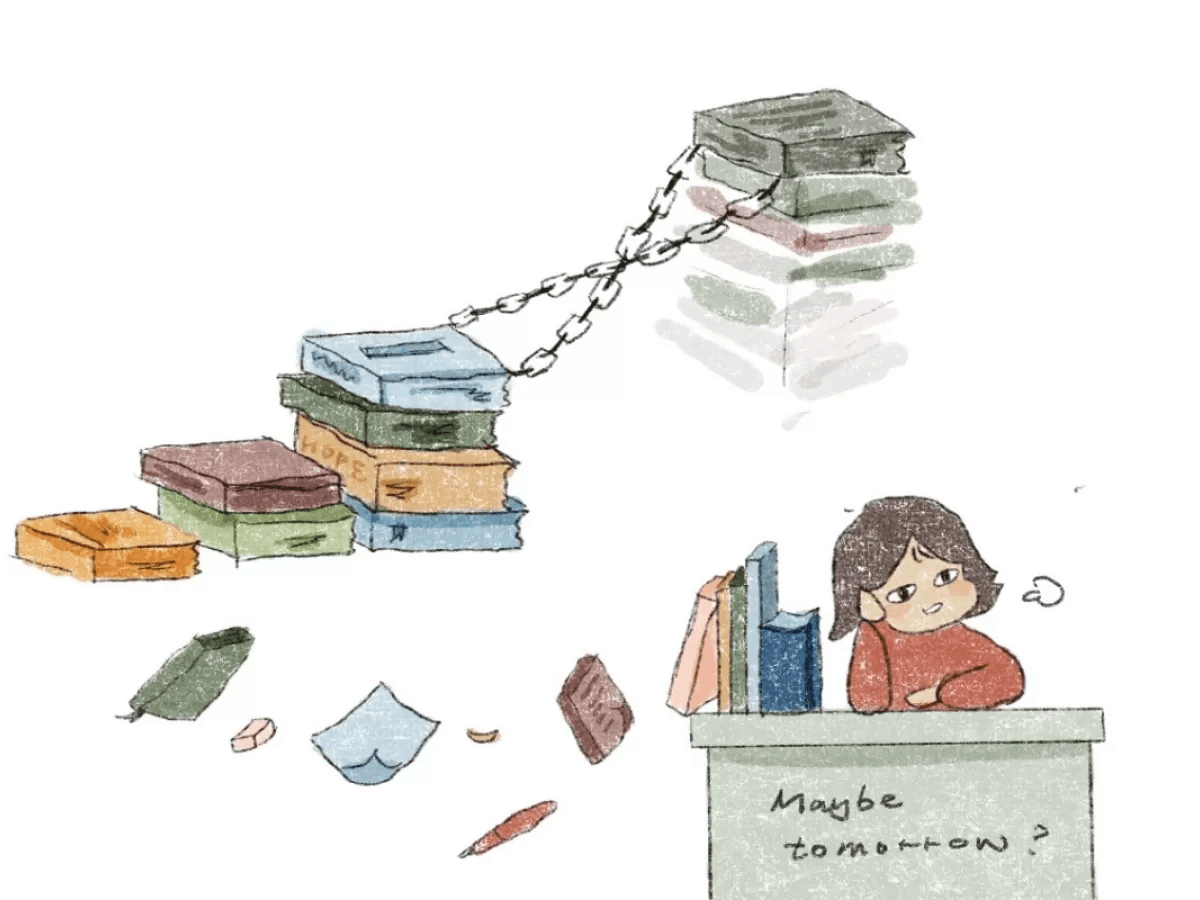
Academic Procrastination Behavior
(Generated with Artificial Intelligence)
Academic Procrastination Behavior
CONCLUSIONS | Performance decline, time pressure, increased psychological burden | ||||||||
|---|---|---|---|---|---|---|---|---|---|
THEORETICAL RELATIONSHIP | Self-regulation processes | ||||||||
AFFECTIVE/MOTIVATIONAL FACTORS | Anxiety, stress, low intrinsic motivation | ||||||||
COGNITIVE FACTORS | Low self-efficacy, fear of failure, perfectionism | ||||||||
DETERMINING VARIABLES | Self-efficacy, motivation, time management | ||||||||
DIMENSIONS | Cognitive, affective, behavioral | ||||||||
SCOPE | Procrastination behavior in educational contexts | ||||||||
DEFINITION | Conscious postponement of academic duties | ||||||||
Academic Procrastination is defined as the conscious delay of academic tasks and responsibilities—such as assignments, exam preparation, projects, or presentations—beyond their planned deadlines, despite awareness that this delay may lead to negative outcomes. This behavior is regarded as a multifaceted phenomenon that affects students’ academic performance, time management, motivation levels, and emotional states. Academic procrastination is not merely a temporary planning issue; it is evaluated as a complex process with cognitive, emotional, and behavioral dimensions.
Academic procrastination is considered the educational context manifestation of general procrastination behavior. Procrastination behavior arises when an individual deliberately postpones a task they are required to perform, and this delay is functionally maladaptive. In an academic context, this manifests as the postponement of tasks such as studying for classes, preparing for exams, submitting projects, or engaging in academic reading.
The literature indicates that academic procrastination is closely linked to self-regulation processes. Self-regulation encompasses the processes of goal setting, planning, maintaining attention, and controlling behavior. Within this framework, academic procrastination is viewed as a behavioral pattern associated with deficiencies in self-regulation skills. Additionally, variables such as time management, motivation, and self-efficacy are stated to play decisive roles in this process.

Academic Procrastination Behavior - Study Environment
(Generated by Artificial Intelligence)
Individual characteristics play a significant role in the emergence of academic procrastination. Low self-efficacy can lead individuals to lack confidence in their ability to complete academic tasks, making it difficult to initiate them. Similarly, fear of failure can cause students to experience anxiety regarding performance evaluation and lead them to avoid the task altogether.
Perfectionism is also among the variables associated with academic procrastination. Individuals who set high standards but experience intense anxiety about the possibility of making mistakes are often found to postpone task initiation. This is explained as being linked to negative expectations regarding performance evaluation.
Academic procrastination behavior is linked to individuals’ tendency to avoid negative emotions. Stress, anxiety, or frustration caused by academic tasks can lead to their postponement. Within this framework, academic procrastination is defined as a behavior that provides short-term emotional relief but results in higher stress and pressure over the long term.
Motivation level is also one of the key determinants of academic procrastination. Low intrinsic motivation or perceiving academic tasks as meaningless can increase the likelihood of task postponement. Therefore, academic procrastination is not only a behavioral delay but also regarded as a motivational process.
It is indicated that academic procrastination has negative effects on academic achievement. Delaying tasks until the last minute increases time pressure and can limit student performance. This situation has been associated with lower academic achievement in various studies.
Moreover, chronic procrastination behavior is associated with increased stress and anxiety. The accumulation of academic responsibilities can heighten an individual’s psychological burden and reduce their level of academic satisfaction. In this context, academic procrastination is evaluated as a behavioral pattern with both academic and emotional consequences.
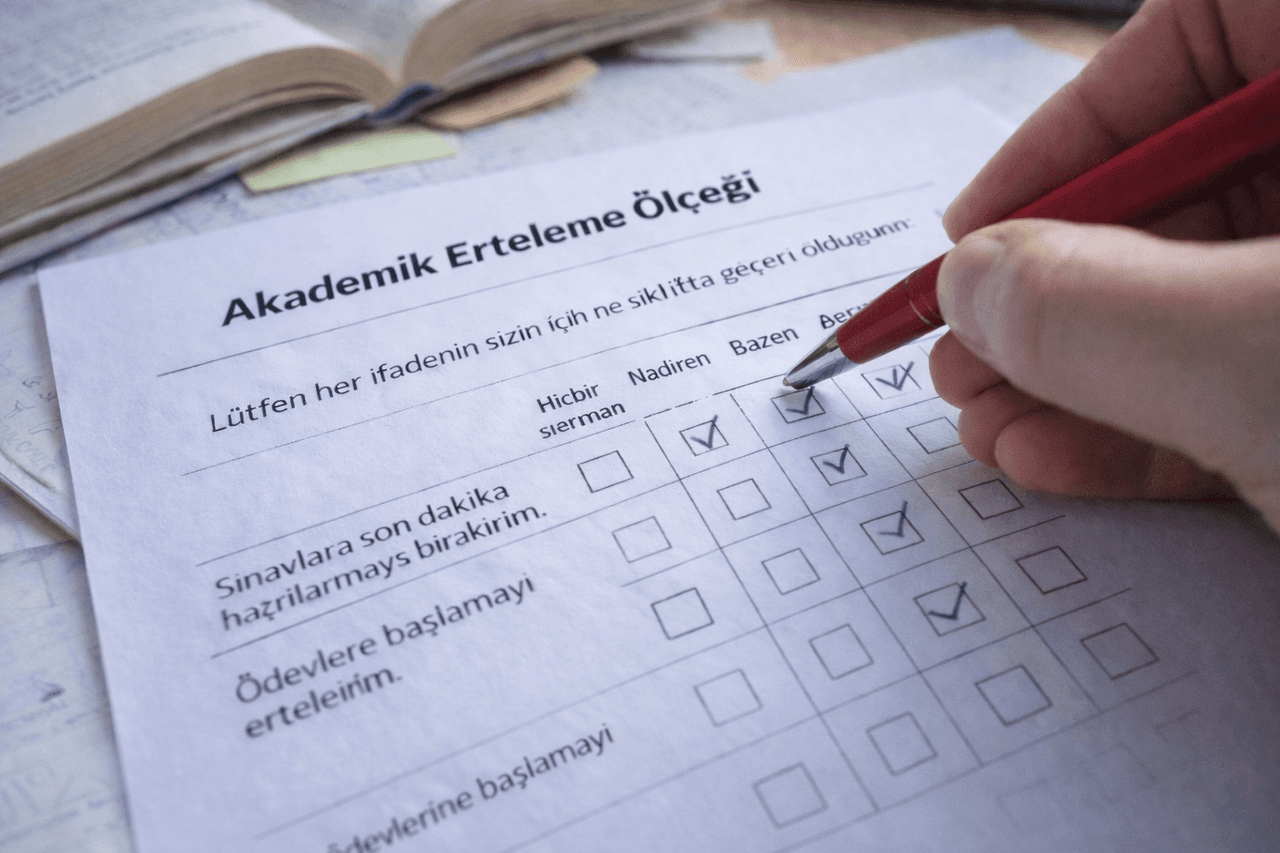
Example of Academic Procrastination
(Generated by Artificial Intelligence)
Various measurement tools have been developed to identify academic procrastination behavior. These scales contain items designed to assess students’ tendencies to delay academic tasks. Validation and adaptation studies involve reliability and validity analyses, and psychometric properties are examined across different sample groups.
Thanks to these measurement tools, the level of academic procrastination can be determined and its relationships with other variables can be statistically analyzed. Thus, academic procrastination has become not only a theoretical concept but also an empirically investigable research area.
Akbay, Sinem Evin, and Cem Ali Gizir. “Cinsiyete Göre Üniversite Öğrencilerinde Akademik Erteleme Davranışı: Akademik Güdülenme, Akademik Özyeterlik ve Akademik Yükleme Stillerinin Rolü.” *Mersin Üniversitesi Eğitim Fakültesi Dergisi* 6, no. 1 (2010): 60–78. Accessed March 4, 2026. https://dergipark.org.tr/tr/download/article-file/160762
Kandemir, Mehmet. “A Model Explaining Academic Procrastination Behavior.” *Pegem Journal of Education and Instruction* 4, no. 3 (2014): 51–72. Accessed March 4, 2026. https://dergipark.org.tr/tr/download/article-file/209597
Ocak, İjlal, Tuğba Akça, and Nilda Hacaoğlu. “Üniversite Öğrencilerinin Akademik Erteleme Davranışları ile Algılanan Stres Düzeyleri Arasındaki İlişkinin İncelenmesi.” *Uluslararası Bilim ve Eğitim Dergisi* 7, no. 2 (2024): 131–154. Accessed March 4, 2026. https://dergipark.org.tr/tr/download/article-file/4156139
Soyer, Alptuğ, and Oktay Yiğit. “Akademik Erteleme ile İnternet Bağımlılığının Boş Zaman Yönetimine Etkisi: Spor Yöneticiliği ve Kamu Yönetimi Öğrencilerinin Karşılaştırılması.” *Herkes için Spor ve Rekreasyon Dergisi* 6, no. 4 (2024): 467–473. Accessed March 4, 2026. https://dergipark.org.tr/tr/download/article-file/4267979
Uzun Özer, Bilge. “Bir Grup Lise Öğrencisinde Akademik Erteleme Davranışı: Sıklığı, Olası Nedenleri ve Umudun Rolü.” *Türk Psikolojik Danışma ve Rehberlik Dergisi* 4, no. 32 (2009): 12–19. Accessed March 4, 2026. https://dergipark.org.tr/tr/download/article-file/200026

Academic Procrastination Behavior
(Generated with Artificial Intelligence)
Academic Procrastination Behavior
CONCLUSIONS | Performance decline, time pressure, increased psychological burden | ||||||||
|---|---|---|---|---|---|---|---|---|---|
THEORETICAL RELATIONSHIP | Self-regulation processes | ||||||||
AFFECTIVE/MOTIVATIONAL FACTORS | Anxiety, stress, low intrinsic motivation | ||||||||
COGNITIVE FACTORS | Low self-efficacy, fear of failure, perfectionism | ||||||||
DETERMINING VARIABLES | Self-efficacy, motivation, time management | ||||||||
DIMENSIONS | Cognitive, affective, behavioral | ||||||||
SCOPE | Procrastination behavior in educational contexts | ||||||||
DEFINITION | Conscious postponement of academic duties | ||||||||
No Discussion Added Yet
Start discussion for "Academic Procrastination Behavior" article
Definition and Theoretical Framework
Causes of Academic Procrastination
Individual and Cognitive Factors
Emotional and Motivational Factors
Consequences of Academic Procrastination
Measuring Academic Procrastination