


This article was automatically translated from the original Turkish version.

Amid the endless pressure of university life and the cycle of midterms and finals, I wanted to carve out a small space for myself to breathe; knitting for me was never just a craft—it became a quiet sanctuary in the midst of chaos. This process, which allowed my eyes to rest from screens and my hands to be occupied with something tangible, gave me not just a few sweaters or scarves by the end of the year, but the ability to remain calm even during my most intense periods. Now, with the rhythmic clicking of those needles as my soundtrack, I am ready to share with you every stitch and every lesson I learned along this journey.
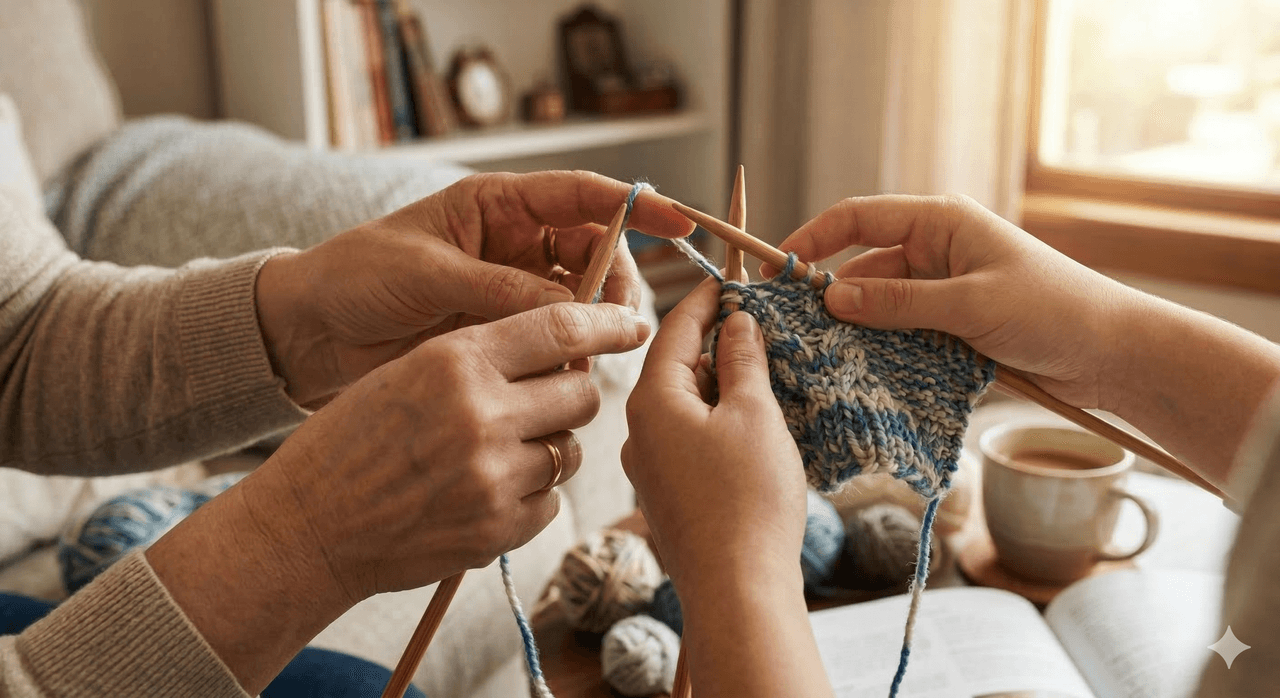
Someone Learning to Knit (Generated by Artificial Intelligence)
While everyone around me prefers to unwind after a long day by starting a TV series or spending time on social media, why do I find myself curled in the corner of my chair with needles in hand? The answer is surprisingly simple: I had grown tired of constantly consuming. University life means constant data input, endless reading, and hours spent in front of screens.
Knitting for me is not merely wool and two needles coming together. It is the only space where I can escape the digital chaos and create something tangible with my own hands. When studying, I must wait months to see the results of my efforts, but in knitting, every stitch is proof of the effort I made in that very moment. I smile and move on when people call it an “old person’s hobby,” because they have never tried to melt their exam stress into the softness of a scarf.
If I were to go back to those first days when I discovered my passion for knitting, I must admit it did not begin professionally at all. Today everyone learns everything from screens, but my teacher was my mother herself. Rather than watching the rapid motions in YouTube videos, sitting beside my mother and trying to follow her hands was far more special to me.
As my mother patiently showed me how to cast on and hold the needles, everything changed when I finally held the needles in my own hands. What I had thought was “how hard could it be?” turned out to be far more difficult than expected. My first attempt was a piece that had intended to become a scarf but resembled more of a “modern art piece”—its beginning and end impossible to determine. I had knit my stitches so tightly that I spent more effort forcing the needles through than I had spent searching for solutions in my lecture notes. The scarf had started with twenty stitches, but by the fifth row, mysteriously, it had grown to twenty-five. As my mother laughed and asked, “Where did you add these?” I thought my knitting was multiplying like my own lecture notes!
That crooked scarf was never completed, nor did it ever warm anyone’s neck. But it taught me the greatest lesson from my mother: patience. After living in a world where even one mistake cost you points, being able to unravel and start again under my mother’s watchful eye, saying “this part didn’t work, but it’s okay,” gave me the most peaceful pause I had ever experienced in my life. Those crooked stitches were, in fact, the first words of a shared language between us—the language that broke my perfectionism.
As I patiently unraveled and reknit beside my mother, I eventually realized my hands no longer struggled against the needles. The stitches began to flow naturally, and those infamous “mysterious increases” disappeared. It was at that moment I understood: I was no longer just doodling for myself—I could now create something “neat enough” to give as a gift to someone else.
Once my hands grew accustomed to the rhythm, my first major project became a scarf I knitted for a friend from high school. In the rush of university life, even though our paths had diverged, this gift was a quiet thank-you for the friendship that had never broken. We had weathered the stress of high school exams together; now, in the midst of university midterms and finals, with every stitch I wove in a little of our old memories, a little of today’s worries, and a little of our laughter.
When I gave her the finished scarf, her stunned reaction—“Did you really make this yourself?”—brought me more satisfaction than any midterm grade I had ever received. To an outsider, it might have looked like just a colorful accessory, but for me, that scarf was the physical embodiment of patience, learning, and a strong bond from the past. Knowing that every time she wore it, it would carry a warmth from our high school days into her university chaos, proved to me why knitting is one of the most beautiful forms of healing.
Why Knitting and Not Something Else?
The First Stitch and the Famous Crooked Scarf
From Crooked Stitches to High School Friendship