


This article was automatically translated from the original Turkish version.
What is cinema? Is it merely the art of moving images, or is it a narrative power that, like looking through a single aperture, reveals only what lies within that opening—defining for you the boundaries of its vision? And what does it mean to be behind the camera? It is not merely a technical position; it is a domain of power that determines the perspective, the story, and the relative truth—often a truth that is not true at all—who constructs it.
For many years, Africa stood in front of the camera, but rarely with its own voice. It was silenced as an object, framed by the Western gaze, its allure rooted in a fabricated “primitiveness” that the Western eye could not comprehend and an exoticized backdrop. Yet the real struggle was to get behind the camera—to tell your own story through your own eyes.
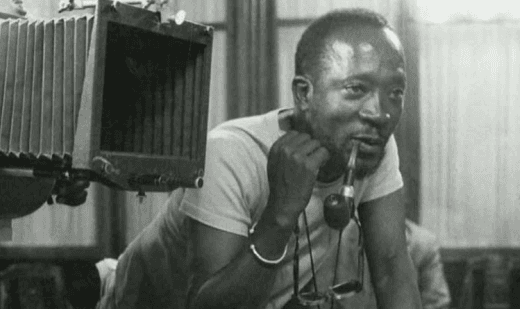
Ousmane Sembène (The Film Study Center at Harvard)
Colonialism did not merely occupy African land; it shaped its history, knowledge, and representation. Africa was narrated through the filter of a Western-centric perspective—one that was both one-sided and stigmatizing. Cinema became one of the key instruments of this regime of representation. Yet at the same time, it also transformed into a powerful site of resistance against this one-sided narrative.
It is at this point that the significance of Ousmane Sembène emerges. He is called the “father of African cinema” not merely because he was the first African to make films in Africa, but because he did far more than that. He used the camera as a tool in a struggle for identity and memory. He became the first African filmmaker to present Africa to the world through the eyes and experiences of Africans themselves.
His cinema was a rebellion against the caricatured oppression imposed by the colonial gaze—that Africans were cannibals or savage tribal members. He made silenced stories visible. Sembène did not merely make films; he built consciousness and ignited resistance through cinema.
Ousmane Sembène was born in 1923 in Ziguinchor, in the Casamance region of Senegal, into a modest family. As a child, he witnessed the everyday inequalities created by colonial rule and personally experienced the class divisions it produced: the white man, the African bourgeoisie collaborating with the colonizer, and the impoverished African stripped of everything.
During the Second World War, he served in the French army as a Tirailleur Sénégalais. This experience gave him a clearer view of the true face of colonial power. After the war, Sembène moved to France, where he worked for many years as a dockworker and laborer in Marseille, joining both the workers’ union and the French Communist Party.
Beginning in 1956, he turned to literature, writing novels and short stories, convinced that writing was the first way to reach his people. But he soon realized that in a continent with low literacy rates, cinema was a far more powerful narrative tool. After Senegal gained independence in 1960, he returned home and traveled across countries such as Mali, Niger, Congo, and the Ivory Coast. These journeys transformed his view of cinema from mere art into a pan-Africanist arena of resistance against cultural and mental colonialism.
His 1963 film Borom Sarret became historically significant as the first short film made in Africa by an African. It criticized class inequality in Dakar and the new bourgeoisie emerging after independence. His next film, La Noire de…, exposed the psychological dimensions of colonial relationships through the tragedy of a young Senegalese woman subjected to racism in France, generating widespread international attention. Mandabi, made in 1968, was the first film ever produced in Africa in an African language—Wolof.
For Sembène, making films in Wolof was extremely difficult. French producers refused to support projects shot in local languages, convinced they would not be financially viable. But Sembène was determined to make his films visible not in Europe but in his own country by using Wolof, Senegal’s most widely spoken indigenous language. Therefore, he shot the film in two versions: first in French, then re-filmed the same scenes in Wolof.
Mandabi was not merely a film; it was a cultural threshold. Centering Wolof was not a temporary preference but the beginning of a deliberate, long-term commitment. He continued to use local languages in his subsequent films, demonstrating that he saw cinema not as a showcase for international festivals but primarily as a space of dialogue with his own people. For him, the time had come for Africa to speak. Cinema must first address Africans. The continent must hear and proclaim its own voice in its own words. African languages were alive and deserved to be seen and heard.
For Sembène, Europe was never a center. In one interview, when asked, “Do your films make sense in Europe?”, he gave this famous reply:
“Let me be frank: Europe is not my center. Europe is around me. They have been here for a hundred years—did they learn my language? I speak their language. I am not bound to Europe. I want them to understand me, but it does not matter. Take the map of Africa, place Europe and America on it—there is still space left. Why should we turn like a sunflower toward the sun? I am the sun itself!”【1】
A Segment from Ousmane Sembène (Youtube)
For Sembène, language was one of the most powerful tools of mental colonialism. Therefore, using local languages was an assertion of cultural independence. His struggle was not only against Western imperialism; he sought to convey something to the people of Senegal, to show them something. He aimed to compel his people to confront themselves, recognize their faults, and develop the will to change. Thus, in his works he criticized colonialism as well as the persistent inequalities after independence, rigid traditions, patriarchal structures, bureaucratic corruption, and the alienation of the new elite class from the masses.
Yet his critique was not external, top-down, or condescending. It was a call for transformation from within, not an attempt at Western-style civilizing. His goal was not to reproduce the judgmental gaze of the West but to dismantle it. He argued that Africa needed no savior from outside—that only Africans could liberate Africa.
For example, in Moolaadé, filmed in Wolof and addressing female genital cutting, he showed that tradition cannot be unquestioned and that change must come from within a society. In the film, transformation does not occur through an external savior but through the resistance of the village women. In this way, Sembène positioned the African woman in cinema as an agent of resistance, transformation, and self-defense. His aim was to contribute to the creation of a fairer, more conscious, and stronger social structure in Africa through its own internal dynamics.
In this sense, Sembène’s cinema was both an anti-imperialist and a self-critical project. When he died in Dakar on June 9, 2007, he left behind not only films but a legacy of consciousness. Thanks to him, the African was no longer merely an object in front of the camera but a subject behind it, looking out at the world.
African Film Festival, Inc. “Caméra d'Afrique (African Cinema: Filming Against All Odds) Restored - Ousmane Sembène Excerpt.” YouTube video, Accessed February 19, 2026.https://www.youtube.com/watch?v=foQ0q4w6z4Q
McMillan-Stewart Fellow. “Ousmane Sembene.” Film Study Center, Harvard University, 2001. Accessed February 19, 2026.https://filmstudycenter.fas.harvard.edu/fellows-works/ousmane-sembene/
[1]
African Film Festival, Inc. “Caméra d'Afrique (African Cinema: Filming Against All Odds) Restored - Ousmane Sembène Excerpt.” YouTube video, Accessed February 19, 2026.
