This article was automatically translated from the original Turkish version.
Recently, a monkey named Punch entered the global spotlight. Born at the Ichikawa City Zoo in Japan, this infant Japanese macaque was abandoned by its mother shortly after birth. This small creature was severed from its most fundamental bond at the very beginning of life. It was raised by caretakers who fed it by hand; however, it was especially emphasized that physical contact and clinging to a mother figure are not merely instinctual but vital needs for primates.【1】
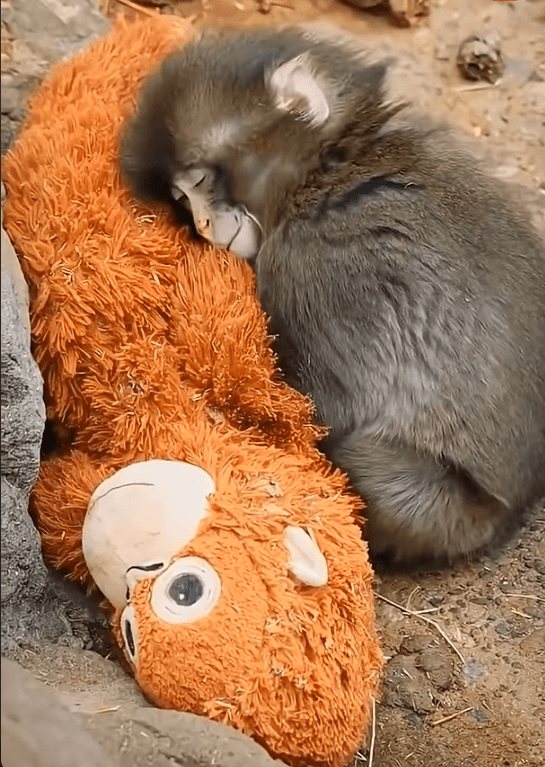
Monkey Punch and the Plush Orangutan Replacing Its Mother (TRT News)
This incident once again demonstrated that loneliness is not uniquely human—even animals, driven by instinct, experience similar emotions. Punch chose a bright orange plush orangutan toy to fill the void left by its mother. The toy was no longer merely an object; it became a “substitute.” It slept with the toy at night, refused to let it go when introduced to other monkeys, and even used it at times as a shield. According to zoo staff, the plush toy served as a kind of “artificial mother” for Punch.【2】
In truth, Punch was trying to cling. It sought to compensate for the absence of its mother, even through a toy, driven by instinct. Even as a monkey, it was searching for something to hold onto. Because the world, for it, was nothing but a branch to grip. Without something to cling to, you drifted into the void of space. Its small arms wrapped around the plush toy were not merely an adorable sight; they were an effort to reconnect with life. Indeed, when another adult monkey eventually accepted and embraced it, that too was another link in this search for connection.
Videos circulating on social media quickly reached millions. Tens of thousands of posts were made under the hashtag #HangInTherePunch; people wrote that they cried for Punch and checked the hashtag every day.【3】 Punch was noticed because it was in front of a camera. Yet there are likely billions of similar cases—unrecorded, untrendy, never turned into a hashtag.
Yet the capitalist system seized its share of this story. Within a very short time, similar products to the toy Punch clung to flooded the market. Because today the world revolves around spectacle. Everything must be bought and sold—even emotions. Emotions that are not bought, not sold, and especially not shared on social media are deemed unnecessary, as if they should never have been felt. Living on social media was cooler than living in the real world. And pain had to find life not as a forgotten age but as a “retweet” or a “favorite.”
The new world order ruled that the artificiality of pain, the exploitation of emotion, and the glorification of only what can be bought and sold were paramount. Punch’s plush toy instantly became a global symbol—but to become a symbol, it first had to be watched, then shared, and finally consumed.
It was not only Punch. In recent days, videos labeled as the “nihilist penguin,” or roosters drowning in floods… The global agenda seemed fixated on animal suffering. When something is brought into the spotlight, it is likely because other things that should be in focus are being deliberately ignored. Of course, there are people who genuinely feel for these images. But the desire to profit from every emotion defines our era.
The focus is on the monkey, the rooster, the penguin.
But what lies outside the spotlight? Children killed for years, lives sketched with a single pen, countless lives lost beneath bombs…
When the subject becomes political, murdered animals are also political—and must be ignored.
Punch is fortunate it was not born in a place where children are murdered. Because there, it could not even cling to its own life.
GZT. “Annesi Tarafından Terk Edilen Punch Adlı Maymun Başka Bir Maymunun Onu Kabul Etmesinin Ardından Ona Sarıldı.” GZT. Accessed February 17, 2026. https://www.gzt.com/eglence/annesi-tarafindan-terk-edilen-punch-adli-maymun-baska-bir-maymunun-onu-kabul-etmesinin-ardindan-ona-sarildi-4017850
Hindustan Times. “Punch the Baby Monkey Goes Viral for His Love for His Plush Toy and Netizens Can’t Get Enough; See Adorable Video.” Accessed February 17, 2026. https://www.hindustantimes.com/world-news/punch-the-baby-monkey-goes-viral-for-his-love-for-his-plush-toy-and-netizens-cant-get-enough-see-adorable-video-101771126813288.html
Mainichi. “In Photos: Punch the Baby Monkey.” The Mainichi. Accessed February 17, 2026. https://mainichi.jp/english/articles/20260217/p2a/00m/0li/008000c
Metro. "Baby Monkey Abandoned by His Mum Only Has a Cuddly Toy for Company." Accessed February 17, 2026. https://metro.co.uk/2026/02/17/baby-monkey-abandoned-by-his-mum-only-has-a-cuddly-toy-for-company-26945123/
TRT Haber. “Annesinin Terk Ettiği Punch Adlı Maymun, Kendisine Verilen Pelüş Maymun Oyuncakla Vakit Geçiriyor.” YouTube video. Accessed February 17, 2026. https://www.youtube.com/shorts/BC1eVyYBSNk
The Standard. "Orphaned Monkey Finds Comfort in Stuffed Toy After Mother’s Rejection." Accessed February 17, 2026. https://www.thestandard.com.hk/world-news/article/324573/Orphaned-monkey-finds-comfort-in-stuffed-toy-after-mothers-rejection
[1]
Mainichi. “In Photos: Punch the Baby Monkey.” The Mainichi. Accessed 17 February 2026. https://mainichi.jp/english/articles/20260217/p2a/00m/0li/008000c
[2]
Mainichi. “In Photos: Punch the Baby Monkey.” The Mainichi. Accessed 17 February 2026. https://mainichi.jp/english/articles/20260217/p2a/00m/0li/008000c
[3]
Mainichi. “In Photos: Punch the Baby Monkey.” The Mainichi. Accessed 17 February 2026. https://mainichi.jp/english/articles/20260217/p2a/00m/0li/008000c