This article was automatically translated from the original Turkish version.
History | 27 September – 10 November 2020 (44 days) | ||||||||
|---|---|---|---|---|---|---|---|---|---|
Side | Azerbaijan and Armenia | ||||||||
Geography | Nagorno-Karabakh and surrounding districts | ||||||||
Turning Points of the War | Southern front advance, UAV/UCAV superiority, capture of Shusha on 8 November, adoption of the trilateral statement on 9–10 November | ||||||||
Main Provisions of the Armistice | Deployment of Russian peacekeeping forces, Lachin corridor and security arrangements, scheduled handover of Agdam, Kelbajar and Lachin, establishment of the Turkey–Russia Joint Observation Center in Agdam | ||||||||
Outcome | Institutionalization of Turkey–Azerbaijan relations through the Shusha Declaration Azerbaijan's recovery of 5 regions 4 towns and 286 villages | ||||||||
2. Karabakh War is a high-intensity conventional conflict that took place between Azerbaijani and Armenian forces between 27 September and 10 November 2020 in Nagorno-Karabakh and its surrounding areas. The primary cause was the de facto occupation of Azerbaijan’s internationally recognized territories by Armenia following the 1990 ceasefire, the stagnation of the Minsk Process, and escalating border tensions in the summer of 2020, which rendered the status quo unsustainable.
The war ended with the entry into force of the trilateral statement signed on 9–10 November 2020, brokered by Russia, following Azerbaijan’s battlefield gains. The agreement provided for the deployment of Russian peacekeeping forces in the region and established corridor arrangements. This war transformed regional power balances and security architecture, institutionalized Turkey–Azerbaijan defense cooperation, and marked the return of displaced Azerbaijani citizens to their lands, initiating a process of reconstruction and political normalization in the region.
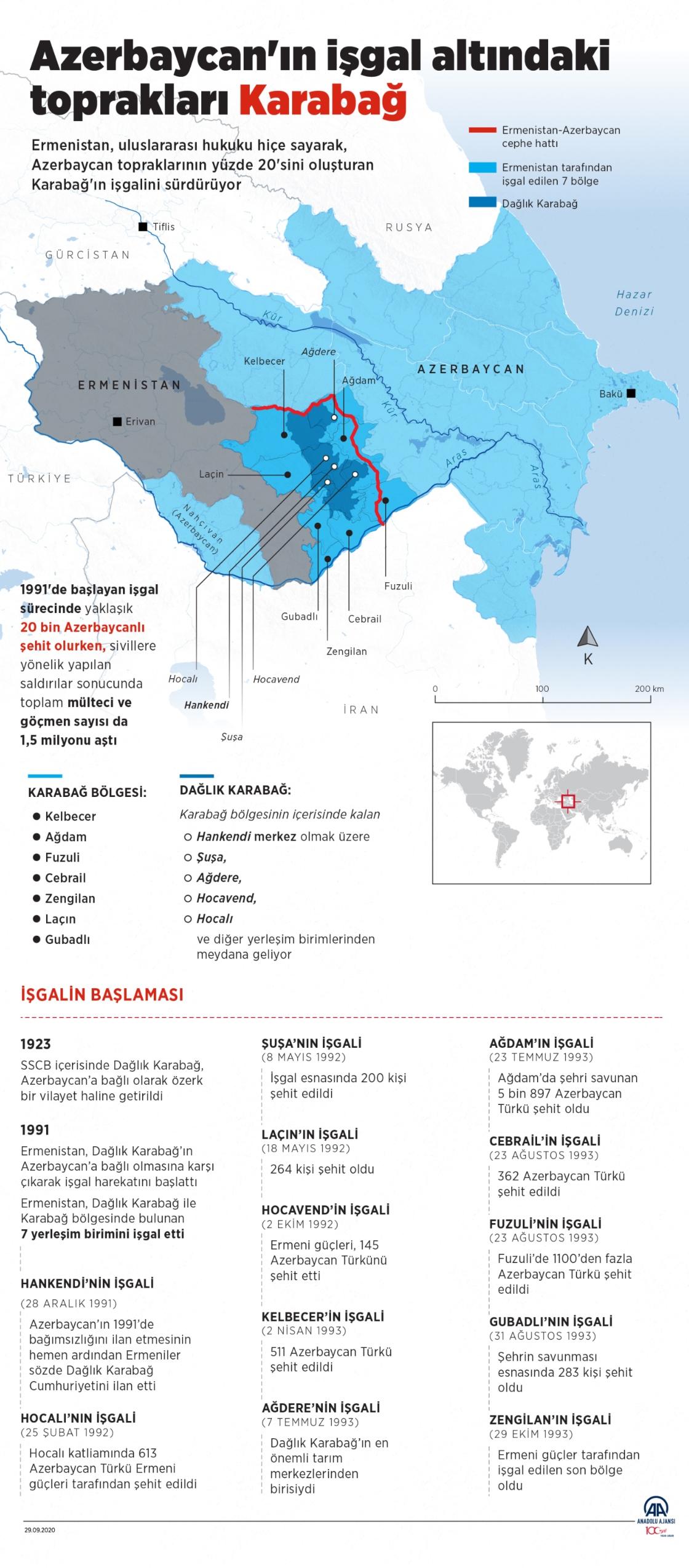
Territories Occupied by Armenia (AA)
Karabakh is a region located at the intersection of east-west transit corridors in the South Caucasus, naturally divided between a mountainous area (Nagorno-Karabakh) and a continental steppe belt. After the collapse of the Russian Empire, the administrative boundaries of the Caucasus changed several times; in 1923, the Soviet authorities established the “Nagorno-Karabakh Autonomous Oblast (NKAO)” within the Azerbaijan Soviet Socialist Republic. The NKAO had a legally subordinate status to Azerbaijan SSR but was granted cultural autonomy. Throughout the Soviet era, authority over external borders remained with Moscow. The mutual dependence between the region’s economic centers (Shusha, Khankendi/Stepanakert) and surrounding districts (Fuzuli, Jabrayil, Zangilan, Kubatli, Agdam, Lachin, Kelbajar) determined the logistical and strategic character of the conflict in subsequent years.
In the late 1980s, the breakdown of central planning and the relative expansion of freedom of expression and organization accelerated ethnic and regional demands. Between 1987 and 1988, petitions calling for a change in status were submitted by the NKAO Council and institutions of the Armenian Soviet Socialist Republic. In February 1988, protests began in Khankendi; social violence incidents (e.g., Sumgait, Kirovabad) deepened the crisis. In 1989, a political movement centered around the “Karabakh Committee” in the Armenian SSR led to the Supreme Soviet of Armenia’s declarative decision on 1 December 1989 to “annex” the NKAO to Armenia. Moscow did not recognize this declaration. From early 1990, armed clashes became widespread among local militias and irregular units, and Soviet Interior Ministry forces failed to restore stability in the region.
With the dissolution of the Soviet Union, Azerbaijan and Armenia declared independence in 1991. Unilateral “referendums” and “declarations of independence” in the NKAO were declared invalid by Baku.
From late 1991, the conflict expanded with more systematic use of conventional elements (artillery, armored vehicles, air units). By 1993, most of the seven surrounding districts of Nagorno-Karabakh had come under Armenian control. The severing of communication lines (via Lachin and Kelbajar to Armenia), sieges, and artillery superiority shaped the battlefield. Civilian populations were displaced, humanitarian aid corridors became necessary, infrastructure was destroyed, and prisoner exchanges occurred.
Occupation of Karabakh (TRT Avaz)
In 1993, the United Nations Security Council adopted Resolutions 822, 853, 874, and 884, calling for respect for Azerbaijan’s territorial integrity, withdrawal from occupied territories, and cessation of hostilities. The resolutions emphasized the obligation to halt the use of force and outlined a framework for returning to negotiations. However, implementation failed to permanently alter the de facto situation on the ground.
In spring 1994, a ceasefire brokered by Russia (through the Bishkek Process) silenced the weapons, but core issues—final status, the sequence of return of occupied districts, and the safe return of displaced persons—remained unresolved. Thus, the conflict entered the category of a “frozen conflict.” While violations of international law regarding borders persisted, no formal peace agreement was reached.
After the ceasefire, the main negotiation platform became the OSCE Minsk Group (co-chairs: Russia, the United States, France). Between 1997 and 2001, “package” and “phased” solution drafts were discussed. The 2007 Madrid Principles and 2009–2011 updates defined the framework parameters for a solution as follows:
The parties interpreted these parameters differently. For Baku, territorial integrity and early withdrawal were the primary priorities; for Yerevan, final status and guarantees of self-rule were decisive. The military balance on the ground was reinforced by deeply entrenched positions along the line of contact, artillery and rocket systems, sniper activity, and mining practices. Between 1994 and 2020, thousands of ceasefire violations occurred, resulting in dozens of deaths, periodic escalations, and diplomatic cycles focused on “managing tensions.”
After the First Karabakh War, hundreds of thousands of people in Azerbaijan (officially cited as approximately 600,000) lived for years under “temporary” housing conditions. Social policy instruments (housing projects, employment, education) were deployed to mitigate the social cost of the conflict. In Armenia and along the Karabakh front, the war’s economic toll, the perception of siege, unsustainable military expenditures, and migration dynamics had significant impacts. In the context of international humanitarian law, the protection of civilians, the fate of casualties and prisoners, mine contamination, and the preservation of cultural heritage became regular agenda items for international monitoring mechanisms (OSCE field missions and reports, etc.).
Throughout the 2000s, oil revenues and defense modernization enhanced Azerbaijan’s military capacity. On the Armenian side, the defense doctrine was based on entrenched positions, firepower, and deterrence. The April 2016 “Four-Day War” triggered a limited but notable shift in the frontline balance and deepened skepticism regarding the effectiveness of the Minsk Process.
Although the 2018 “Velvet Revolution” in Armenia briefly revived the tone of negotiations, no flexibility emerged between the positions of the parties in 2019–2020. In July 2020, clashes along the Tovuz/Tavush segment of the Armenia–Azerbaijan state border revealed risks extending beyond the frontline—particularly the proximity to energy and transport routes. This scenario confirmed that the conflict, labeled as “frozen,” contained inherent fragilities capable of erupting into open warfare at any moment.
The factors leading to the Second War were:
The First Karabakh War, ending with the 1994 ceasefire, produced a balance in which “weapons were silent but the conflict was not frozen.” This balance proved unsustainable due to the contradiction between the internationally recognized framework and the de facto situation on the ground, the unresolved humanitarian and demographic consequences, and the implementation crises of diplomatic formulas. The periodic escalations, military modernization, and hardening of rhetoric throughout the 2010s gradually laid the groundwork for the Second War, which erupted in the autumn of 2020.
The main framework after the 1994 ceasefire, the OSCE Minsk Group, developed proposals over the years such as “package,” “phased,” and “shared state” solutions, but none translated into a binding agreement. There was a ceasefire, but no solution.
While political change occurred in Armenia after 2018, rhetoric along the Baku–Yerevan line did not soften. Prime Minister Nikol Pashinyan’s statement, “Artsakh is Armenia. Period.,” referring to the entity established in Karabakh as a “bandit state,” strained peace negotiations.【1】 This rhetoric was recorded as a threshold that heightened mutual distrust and made the fragile balance on the ground more precarious.
On 12 July 2020, heavy fighting erupted along the Tovuz/Tavush segment of the Azerbaijan–Armenia state border, outside the Karabakh frontline, involving heavy weapons. Azerbaijani sources described the incident as “an Armenian attack including heavy artillery,” while Armenian sources claimed “an attempt by an Azerbaijani vehicle to cross the border.”
Tovuz’s importance lay in its role as a node for energy and transport corridors. The Baku–Tbilisi–Ceyhan and Baku–Supsa oil pipelines, the Baku–Tbilisi–Erzurum and TANAP natural gas pipelines, and the Baku–Tbilisi–Kars railway all passed through this corridor. Thus, any escalation along the border served not only as a warning to the frontline balance but also as a signal regarding regional energy security.
Throughout the 2010s, ceasefire violations, sniper fire, and artillery shelling resulted in casualties. The escalation in summer 2020 was one of the peaks of this “attrition cycle.”
The “Strategic Partnership and Mutual Assistance Agreement” signed between Turkey and Azerbaijan in 2010 included provisions for urgent consultations and joint defense commitments in the event of any threat. From the 2010s onward, defense, training, and joint exercises institutionalized relations. This framework became a frequently referenced point in assessments that Turkey and Azerbaijan had increased their security coordination in the summer of 2020. That same summer, official announcements reached the public regarding Azerbaijan’s efforts to procure Bayraktar TB2 drones from Turkey.
Azerbaijani Armed Forces Conducting Drills with Bayraktar TB2 (TRT Haber)
The war became visible on 27 September 2020, when clashes erupted along the contact line during daylight hours. The Azerbaijani Ministry of Defense announced that Armenian units in Karabakh had targeted civilian settlements. In response, Azerbaijan launched a “counter-offensive” along the entire front. In the initial weeks, a combat scenario emerged involving intensive artillery and missile fire, armored units, special forces, and the extensive use of aerial assets—particularly UAVs/UCAVs.
The decisive axis of the war was the southern front, where Azerbaijan broke through. Pressure along the Fuzuli–Jabrayil–Zangilan–Kubatli direction disrupted supply lines and positions, enabling advances. The capture of cities, towns, and villages was gradually announced.
By 29 October, official reports indicated that “four cities, four towns, and approximately 180 villages” had been recaptured. In the northern and central sectors, a balance dominated by positional defense and attrition was more evident.
On 10 October, a first “humanitarian ceasefire” was declared following a meeting in Moscow, but it collapsed almost immediately due to violations, and fighting continued. During this period, both sides accused each other of breaches. In the days following the ceasefire, renewed artillery and missile fire were reported, and intense battles persisted along the contact line.
Azerbaijan’s most conspicuous advantage during the 44 days was its use of UAVs/UCAVs, which combined reconnaissance and precision strike roles. First, air defense and command-and-control targets were suppressed. Subsequently, waves of attacks targeting armored units and forces in open areas generated “information and psychological superiority” on the battlefield. Numerous analyses have noted that the shock effect and morale-degrading imagery produced by UCAVs played a significant role in shaping the course of the war.
Role of Turkish UCAVs in the Karabakh Victory (TRT Haber)
During the conflict, settlements behind the frontlines also came under fire, resulting in severe consequences. International human rights organizations documented attacks on Barda and Ganja in separate reports. These strikes, involving cluster munitions and indiscriminate attacks, fueled international debates on humanitarian law. Academic studies on the laws of war emphasized the importance of documenting violations during the 44-day conflict and pursuing judicial accountability.
In the first week of November, the focus of combat shifted to Shusha. After a phase defined by steep terrain and urban close-quarters fighting, the capture of Shusha by Azerbaijan on 8 November became the war’s decisive moment, due to both its strategic position and symbolic value.
The fall of Shusha led to the encirclement of Khankendi (Stepanakert) and threatened Armenian forces’ withdrawal and supply lines. These developments are cited as the primary factors compelling Yerevan to accept the ceasefire.
Documentary on the Liberation of Karabakh by Azerbaijan (Haber Global)
Following a video conference on the night of 9 November, the ceasefire statement was signed by Azerbaijani President Ilham Aliyev, Armenian Prime Minister Nikol Pashinyan, and Russian President Vladimir Putin. Hostilities ceased at 00:00 Moscow time on 10 November. The ceasefire text provided for the deployment of Russian peacekeeping forces, established connectivity via Lachin, and outlined a timetable for redeployment and withdrawal in specific areas; Russian forces subsequently entered the region.
Recognition of the new battlefield situation: Azerbaijan’s control over territories captured during the war was confirmed; specific districts (Agdam, Kelbajar, Lachin) were scheduled for handover on designated dates.
Peacekeeping force and monitoring: The deployment of Russian peacekeeping forces was formalized. Subsequently, the Turkey–Russia Joint Monitoring Center was established in Agdam, tasked with monitoring ceasefire violations.
Transport corridors: The Lachin corridor was secured to maintain connectivity between Armenia and Karabakh; new transport links between Azerbaijan’s western districts and Nakhchivan (via the Zangezur corridor) were introduced.
Azerbaijani Couple Reunited with Their Homeland After the Capture of Shusha (AA)
Turkey adopted a stance during the Second Karabakh War that affirmed its “strategic partnership and mutual assistance” alignment with Azerbaijan. In its diplomatic rhetoric, Turkey emphasized Azerbaijan’s territorial integrity and legitimate right to self-defense. On the battlefield, Turkey provided military and technical support without directly deploying combat units. This support included the provision of Bayraktar TB2 and other UCAV/UAV systems, training and technical adaptations for their effective use in target detection, designation, and damage assessment cycles, integration of joint concepts for artillery/rocket fire, and sharing of combat intelligence, reconnaissance, and surveillance (C4ISR).
The rhetoric during the war was consistent with the natural continuation of the bilateral security framework established in 2010. After the war, Turkey participated with Russia in establishing the Joint Monitoring Center in Agdam, becoming part of the 24/7 monitoring capacity for ceasefire implementation. In the post-war period, relations were elevated to an institutional threshold with the 15 June 2021 “Shusha Declaration on Allied Relations between the Republic of Turkey and the Republic of Azerbaijan”. The declaration consolidated under a single framework the shared defense and security concept, defense industry cooperation, continuity of joint exercises, and integration of transport and energy corridors (particularly the Nakhchivan connection and Zangezur axis), explicitly formalizing the “allied” status of the two countries. Thus, Turkey’s military and technical role during the war was transformed into a permanent security, economic, and transport architecture in the post-war era.
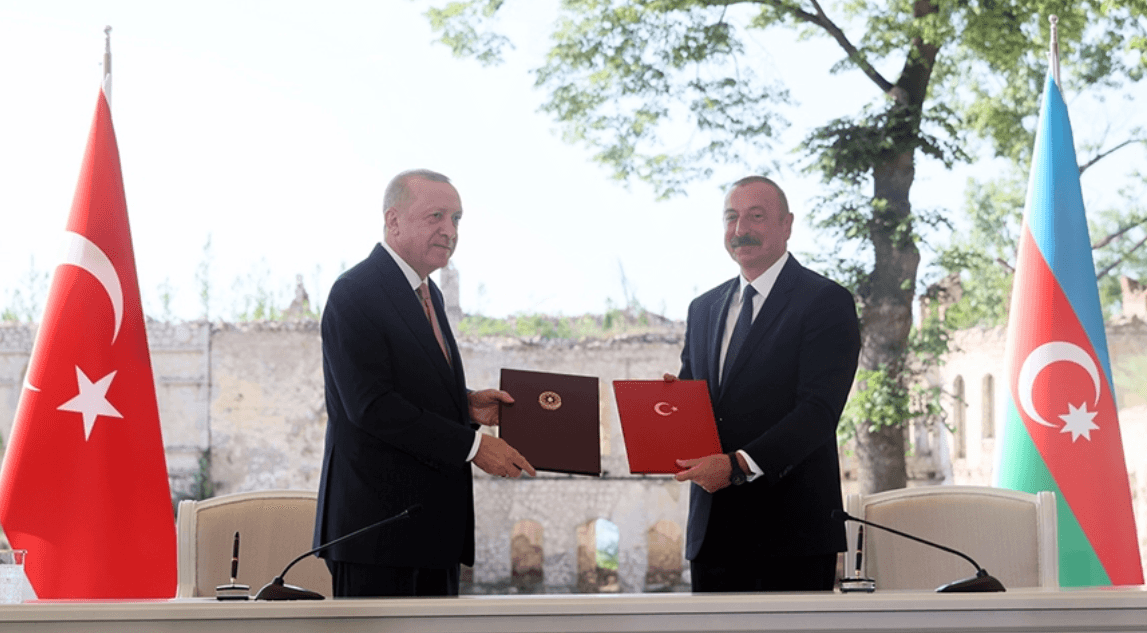
Presidents Erdoğan and Aliyev Signing the Shusha Declaration (AA)
Russia emerged as the primary actor shaping the ceasefire. It subsequently deployed a 1,960-person peacekeeping force along the Lachin Corridor and the contact line to oversee the new order on the ground. The peacekeeping force not only monitored the ceasefire but also assumed roles in mine clearance, organizing returns, and ensuring access to religious sites—a move interpreted as Russia’s effort to position itself as a “permanent actor” in the region.
After the Second Karabakh War, the Russian Peacekeeping Force, which had been temporarily stationed in the Karabakh region, completed its mission and withdrew from the area.
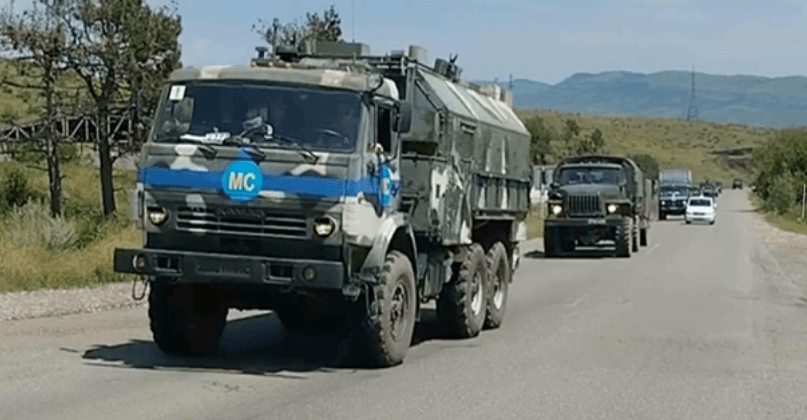
Russian Peacekeeping Forces Departing Karabakh (AA)
Iran interpreted the Second Karabakh War primarily through the lens of border security and internal stability. Azerbaijan’s rapid military advance, its defense cooperation with Turkey, and the perceived increase in military-technical capacity linked to Israel heightened security concerns in Tehran. Sensitivities among Iran’s own Azerbaijani Turk population added to these concerns. Consequently, while Iran emphasized the principles of territorial integrity and the immutability of borders in its official rhetoric, its primary objective was to prevent the conflict from spilling over into its own borders and disrupting its demographic balance.
While the conflict continued, Iranian authorities made allegations that third-country elements were present in Azerbaijan and that fighters had been transported from Syria. The “presence of Israel” was frequently raised in this context. Tehran simultaneously deployed military forces along its border, maintained its air defense and border units on high alert, and issued formal protests to both sides when artillery shells occasionally landed on Iranian territory, calling for restraint.
Iran’s stance during the Karabakh War did not align with Azerbaijan’s expectations and was associated with various political and practical support claims toward Armenia. In this context, Iran’s conduct of a military exercise named “Hayber Fatihleri” near its border, its closure of airspace to cargo flights destined for Nakhchivan, and its post-war criticism of Baku attracted attention.
As a co-chair of the OSCE Minsk Group, France attempted to maintain a neutral mediator image during the process, but its public communication and media practices during and after the war created the impression of alignment with Yerevan. French official news agencies and mainstream media consistently promoted a narrative favorable to Armenia, generating an image inconsistent with its co-chair status.
In French media, the war was frequently framed under headlines such as “Christian–Muslim,” “war driven by Turkish encouragement,” or “Ankara’s Ottomanist/competitive expansion.” The claim that Turkey supported Azerbaijan not out of “brotherhood” but for its own interests was repeatedly echoed. Central motifs in this narrative included allegations that Turkey had brought “jihadist/mercenary fighters” from Syria, posing a threat to regional security. Thus, France aimed not only to evoke sympathy for Armenia but also to generate an opposing public opinion atmosphere toward Turkey and Azerbaijan.
In content directed at the French public, Turkey and President Erdoğan were predominantly portrayed as a “revisionist/Ottomanist foreign policy actor seeking influence in the region and escalating the conflict.” Erdoğan’s “challenges” to France were emphasized, with the view that this stance reinforced his domestic nationalist coalition and was interpreted alongside other points of friction between Turkey and France (Libya, Syria, Eastern Mediterranean). This narrative embedded the Karabakh context within a broader Paris–Ankara tension axis, reinforcing anti-Turkey sentiment in French public opinion.
The United States and the European Union generally positioned themselves along a “balancing/mediating” line during the Second Karabakh War, aiming to halt hostilities and bring the parties back to negotiations. In this framework, a humanitarian ceasefire initiative was announced on 26 October 2020 under U.S. mediation, but it did not have a lasting impact on the ground. This approach was reflected in public opinion. Mainstream U.S. media adopted a reporting tone that shared responsibility between the parties, emphasized the humanitarian dimension of the conflict, and sought balance.
In the institutional-political aftermath of the war, Russia’s decisive role on the battlefield and at the negotiating table was highlighted, while the OSCE Minsk Group umbrella and the regional influence of the West (U.S./EU) receded relatively. The emerging new security architecture, centered around the Russian peacekeeping force and the Turkey–Russia Joint Monitoring Center, limited the effectiveness of Western actors.
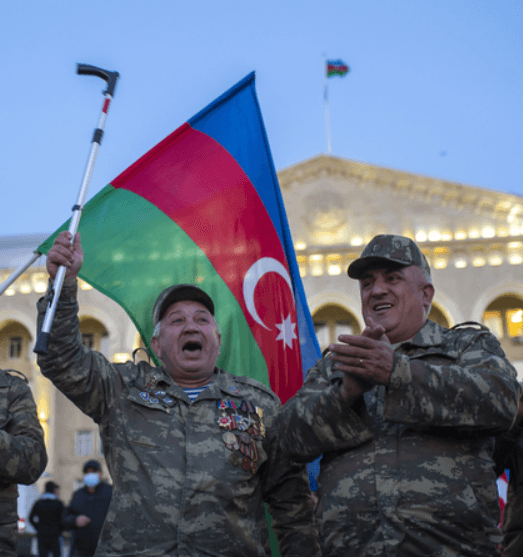
The nationalist sentiments observed during the Second Karabakh War were not confined to ethnic nationalism mobilized against an “external threat/enemy”; they transcended the geography of Karabakh and Azerbaijan to trigger a regional form of Turkish nationalism. This mobilization was built upon the central place of Karabakh in Azerbaijan’s historical memory (as an inseparable part of identity) and the collective surge of pride and loyalty generated by the victory.
From the first hours of the war, Turkey provided open and decisive diplomatic support, shattering the perception of isolation in Azerbaijani public opinion and transforming the slogan “One Nation, Two States” into a concrete practice of solidarity. The emphasis placed on the role of the Turkish Armed Forces in official statements and operational planning nurtured combat morale and conveyed to broad audiences the message that Azerbaijan was fighting alongside a powerful ally. As a result, this support led even the opposing side to perceive the war as a “joint operation,” thereby expanding the legitimacy and self-confidence of the nationalist discourse.
The war, closely followed by Azerbaijanis in Iran (particularly through media and social media), also generated a ripple effect within Iran’s domestic politics. This visibility and sensitivity weakened Iran’s influential position during the First Karabakh War; Tehran’s overt pro-Armenian stance became politically difficult due to internal backlash, resulting in a rise in nationalist sentiments among Iran’s Azerbaijani Turks. Thus, the wave of nationalism in Azerbaijan transformed into a transnational identity politics, affecting the regional balance.
Altınalan, Hüseyin. “II. Karabağ Muharebesi Sürecinde Fransız Medyası.” *International Journal of Humanities and Education* 9, no. 19 (2023): 49–68.https://dergipark.org.tr/en/download/article-file/3043858
Anadolu Ajansı. "Azerbaycan'ın işgal altındaki toprakları Karabağ." Accessed September 26, 2025.https://www.aa.com.tr/tr/azerbaycan-cephe-hatti/azerbaycanin-isgal-altindaki-topraklari-karabag/1989594
Anadolu Ajansı. "İran Karabağ savaşının kaybedeni mi?" Accessed September 26, 2025.https://www.aa.com.tr/tr/analiz/iran-karabag-savasinin-kaybedeni-mi/2052813
Anadolu Ajansı. "İran'ın Azerbaycan Siyaseti." Accessed September 26, 2025.https://www.aa.com.tr/tr/analiz/iranin-azerbaycan-siyaseti/2396577
Anadolu Ajansı. "Şuşa Beyannamesi'nin 3. yılı." Accessed September 26, 2025.https://www.aa.com.tr/tr/dunya/susa-beyannamesinin-3-yili/3250617
Erarslan, Fatih, and Fatma Nur Özdemir. “Azerbaycan-Türkiye İlişkilerinde Önemli Bir Kavşak: İkinci Karabağ Savaşı.” *Türk Dünyası Araştırmaları* 129, no. 255 (2021): 315–334.https://dergipark.org.tr/tr/pub/tda/issue/67799/1017390
Ghanbarlou, Raheb Mohammadi. “İkinci Karabağ Savaşı’nın Azerbaycan Türk Milliyetçiliğine Etkileri.” SDE Akademi Dergisi 2, no. 5 (2022): 12–39.https://dergipark.org.tr/tr/pub/sde/issue/70096/1105173
Haber Global YouTube Channel. "Azerbaycan Karabağ’ı işgalden adım adım işte böyle kurtardı!" Accessed September 26, 2025.https://www.youtube.com/watch?v=JWf3WtXLoeM
Hasanoğlu, Murteza, Asim Memmedov and Bahtiyar Maharramov. "İkinci Karabağ Savaşı Sonrası Azerbaycan - Türkiye İlişkileri." Uluslararası Yönetim Akademisi Dergisi 3, no. 3 (2020): 522–529.
Kocatürk, Burak. *Değişen Güvenlik ve Savunma Anlayışı Kapsamında Silahlı İnsansız Hava Aracı (Bayraktar TB2) Kullanımı: 2. Karabağ Savaşı Örneği.* Master's thesis,Gaziantep Üniversitesi, Institute of Social Sciences, 2024.https://tez.yok.gov.tr/UlusalTezMerkezi/TezGoster?key=1pwTzRXnomYf6jwqVORfUaCPGclHmr-KNlwroW7PgFwsl2EbfsrMCDNrUxVgIyhG
Sapmaz, Ahmet. “İran’ın Azerbaycan’a Yönelik Dış Politikası: İkinci Karabağ Savaşı’nın Belirleyiciliği.” *SDE Akademi Dergisi* 2, no. 4 (January–April 2022): 12–43.https://www.sdeakademidergisi.org/pdf/makale1-1.pdf
TRT Avaz. "Karabağ'ın İşgali Sonucunda Azerbaycan'da Neler Yaşandı?" Accessed September 26, 2025.https://www.youtube.com/watch?v=L-SzxhsJXpE
TRT Haber YouTube Channel. "Karabağ zaferinde Türk SİHA'larının rolü." Accessed September 26, 2025.https://www.youtube.com/watch?v=Ug8y-DpF2eA
TRTHaber Youtube Channel. "Azerbaijan Conducted Drills with 'Bayraktar SİHA." Accessed September 26, 2025.https://www.youtube.com/watch?v=Z88A6Xz1d34
Taşçıoğlu, Ömer Lütfi. “İkinci Karabağ Savaşı ve Sonuçları.” Trakya Üniversitesi Sosyal Bilimler Dergisi 25, no. 2 (December 2023): 543–566.https://dergipark.org.tr/tr/pub/trakyasobed/issue/81648/1185429
Yüksel, Cüneyt, and Hamza Yüce. “Uluslararası Hukuk Açısından Dağlık Karabağ Sorunu ve İkinci Dağlık Karabağ Savaşı’nı Sona Erdiren Ateşkes Andlaşması.” İstanbul Hukuk Mecmuası 80, no. 3 (2022): 1021–1065.https://dergipark.org.tr/en/pub/ihm/issue/72608/1184627
Özdaşlı, Esma. “İkinci Karabağ Savaşı’nda Ermenilerin Sivillere Yönelik Saldırılarının Uluslararası İnsancıl Hukuk Açısından Değerlendirilmesi.” Giresun Üniversitesi İktisadi ve İdari Bilimler Dergisi 7, no. 1 (2021): 51–83.https://dergipark.org.tr/tr/pub/guiibd/issue/60358/869018
Özgen, Cenk. “44 Günün Ardından: 2020 Karabağ Savaşı’nın Askerî Açıdan Analizi.” Giresun Üniversitesi İktisadi ve İdari Bilimler Dergisi 7, no. 1 (2021): 104–123.https://dergipark.org.tr/tr/pub/guiibd/issue/60358/849560
[1]
Ömer Lütfi Taşçıoğlu, “İkinci Karabağ Savaşı ve Sonuçları,” Trakya Üniversitesi Sosyal Bilimler Dergisi 25, no. 2 (2023): 548. https://dergipark.org.tr/tr/pub/trakyasobed/issue/81648/1185429

History | 27 September – 10 November 2020 (44 days) | ||||||||
|---|---|---|---|---|---|---|---|---|---|
Side | Azerbaijan and Armenia | ||||||||
Geography | Nagorno-Karabakh and surrounding districts | ||||||||
Turning Points of the War | Southern front advance, UAV/UCAV superiority, capture of Shusha on 8 November, adoption of the trilateral statement on 9–10 November | ||||||||
Main Provisions of the Armistice | Deployment of Russian peacekeeping forces, Lachin corridor and security arrangements, scheduled handover of Agdam, Kelbajar and Lachin, establishment of the Turkey–Russia Joint Observation Center in Agdam | ||||||||
Outcome | Institutionalization of Turkey–Azerbaijan relations through the Shusha Declaration Azerbaijan's recovery of 5 regions 4 towns and 286 villages | ||||||||
Historical Background of the War
Geographical and Administrative Framework
Late Soviet Period and the Onset of the Crisis (1987–1991)
Collapse of the Soviet Union and Escalation of the War (1991–1994)
United Nations Security Council Resolutions and the Status Quo
The Minsk Process (1994–2019)
Unsustainability of the Status Quo
Pre-2020 Triggers: Tovuz Clashes, Political Rhetoric, and Border Violations
The Start of the War and Its 44-Day Course
Ceasefire Initiatives
Combat Methods: UAVs/UCAVs, Firepower, and Information Superiority
Impact on Civilians and Humanitarian Law Debates
Capture of Shusha by the Azerbaijani Armed Forces: The Turning Point of the War
9–10 November: Ceasefire Statement and the End of Hostilities
Key Arrangements of the Ceasefire Agreement
Outcomes of the Second Karabakh War
Military Outcomes
Political–Diplomatic Outcomes
Economic Outcomes
Social Outcomes
International Responses
Turkey
Russia
Iran
France
United States and European Union
Contribution of the Second Karabakh War to Turkish Nationalism