


This article was automatically translated from the original Turkish version.
The Second Battle of Ypres was a significant engagement fought on the Western Front of the First World War, near the Belgian town of Ypres (Ieper), between 22 April and 25 May 1915. This battle is historically notable as the first large-scale use of poison gas (chlorine) as a weapon in warfare.
In the spring of 1915, the German army aimed to conduct a limited offensive on the Western Front. The primary objectives were to conceal the movement of troops being transferred to the Galicia Front, break the Allied pressure on the Ypres Salient, and shorten the defensive line to establish a new defensive arrangement. Although intelligence reports reached British and French headquarters on 14 April 1915 indicating that the Germans planned to use poison gas, the troops were not adequately informed about the effects of such an attack.
On 22 April 1915, German forces released approximately 150 to 180 tons of chlorine gas against the northern section of the Ypres Salient, where French and Algerian units were positioned. This first attack created a major breach in the Allied defenses; the French lines collapsed and thousands of soldiers either died from the gas or were forced to abandon their positions. On 24 April, a second gas attack was launched against Canadian units. However, this time the defense was more resilient. Despite heavy casualties, the Canadian forces held their ground and limited the German advance.
Around 17:00, near the village of Langemark northwest of Ypres, the German Fourth Army released 168 tons of chlorine gas stored in 5,730 cylinders, carried by westerly winds toward the French lines.
Chlorine gas caused suffocation and internal bleeding by producing an acidic effect in the lungs. French soldiers without protective equipment panicked. A front line approximately 6 km wide completely collapsed. The French suffered over 6,000 casualties; many soldiers died instantly or fled while choking. The Germans, instead of exploiting the initial shock, hesitated and delayed their advance. As a result, the large gap created was not fully exploited.
Following the first attack, the Canadian 1st Division was forced to defend the front line after the French positions had been breached. Two days later, on the morning of 24 April, the Germans launched another chlorine gas attack, this time directly targeting Canadian troops.
Canadian units attempted to protect themselves using improvised methods such as wet cloths and fabric soaked in urine. The cloths covering their mouths and noses provided temporary protection. Despite heavy losses, the Canadian 1st Division did not abandon their positions, preventing the fall of Ypres.
This attack marked the first institutionalized use of chemical weapons in warfare. Its impact was devastating both militarily and psychologically. In the aftermath, the Allies, beginning with Britain and France, began producing chemical weapons themselves. Gas mask usage rapidly expanded. By the end of 1915, the British began using phosgene gas; in 1917, the Germans developed the more lethal mustard gas (iprit).
The first gas attack (22 April) targeted French-Algerian units. As the attack was unexpected, no protective equipment was available. During the second attack (24 April), which targeted Canadian troops, some improvised measures were adopted.
Soldiers used handkerchiefs, socks, and pieces of cloth to cover their mouths and noses. These cloths were soaked in water or urine in an attempt to prevent chlorine from entering the respiratory system. Since chlorine is soluble in water, damp fabric could filter out a portion of the gas.
Chlorine gas is heavier than air and settles near the ground. Soldiers therefore crouched at the bottom of trenches to breathe cleaner air and attempted to adjust their positions according to wind direction. However, this was often impossible and provided only limited protection.
After the Second Battle of Ypres, the British and French began developing systematic protective measures against chemical attacks.
This mask consisted of a fabric hood designed to cover the entire face. The interior was treated with a chemical absorbent solution such as sodium thiosulfate. However, its effectiveness was limited and provided only short-term protection against chlorine gas.
An improved version of the previous model, it featured an absorbent layer made of chemicals such as carbonate and thiosulfate. Celluloid glass eye protectors were added.
The French initially recommended cotton handkerchiefs. They later used simple systems combining cotton and gas mask materials. From 1916 onward, more advanced models with active carbon filters were produced.
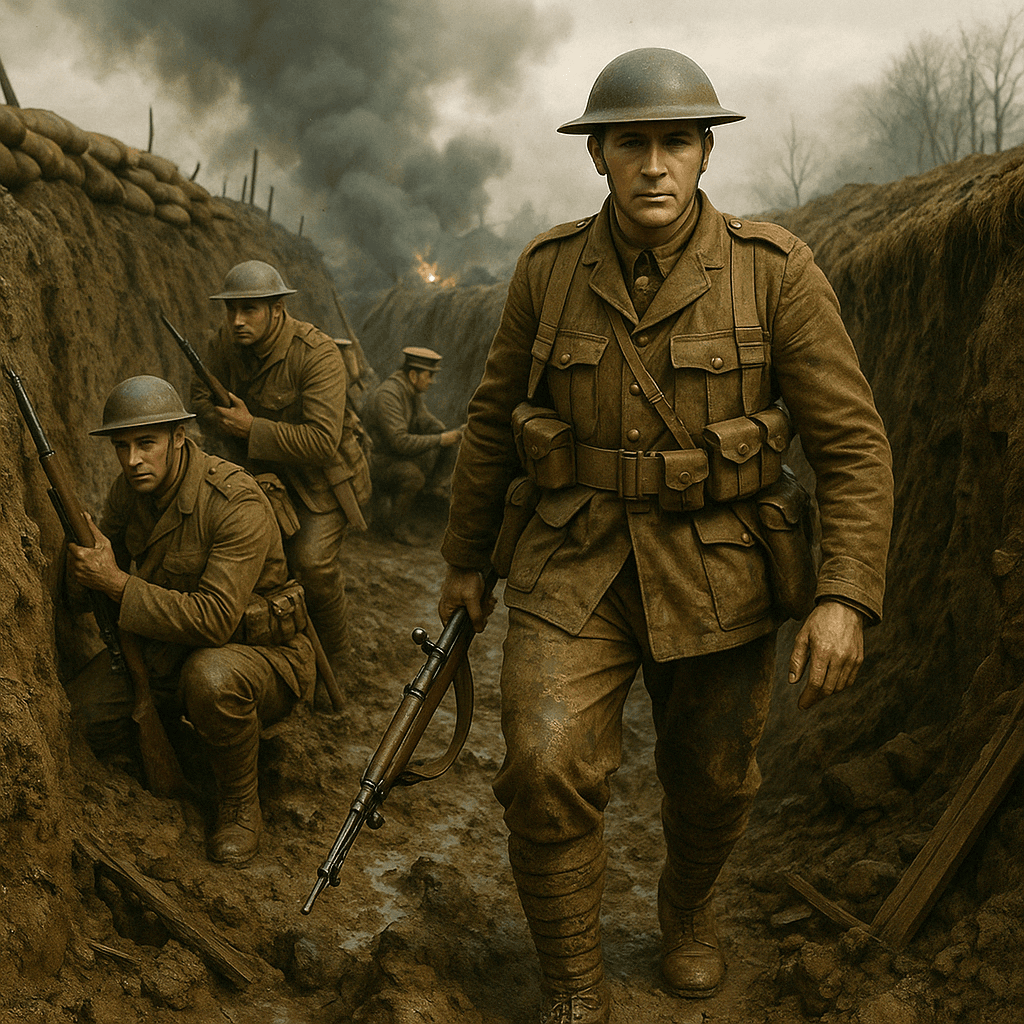
An Image Representing the War (Generated by Artificial Intelligence.)
No clear victor was determined at the end of the Second Battle of Ypres. Both sides suffered heavy losses: the Allied Powers lost approximately 70,000 troops and Germany approximately 35,000. The town of Ypres and its surroundings were largely destroyed, but the Allies succeeded in holding the town.
By the end of the battle, the Ypres Salient had been reduced in size, and part of the high ground had fallen into German hands. However, the Germans failed to capitalize on this strategic advantage with a decisive victory.
The Second Battle of Ypres marked the turning point that initiated the use of chemical weapons in modern warfare. This practice, initiated by the Germans, was subsequently adopted by the British, the French, and later the Americans who entered the war. The use of more lethal substances such as mustard gas in 1917 intensified the impact of chemical warfare.
This battle left a lasting mark not only through its military consequences but also through its cultural impact. The poem “In Flanders Fields” by Canadian doctor John McCrae was written in memory of those who died in this conflict, and the poppy flower became one of the symbols of the First World War.
The Second Battle of Ypres is regarded in military history as the beginning of chemical warfare and a symbol of the brutality of modern war. Although the Germans failed to achieve significant military gains, the humanitarian tragedy unleashed by the use of chlorine gas has left a dark stain on the history of warfare.
Canadian War Museum. "Second Battle of Ypres." Canadian War Museum – First World War Gallery. Accessed April 22, 2025.https://www.warmuseum.ca/firstworldwar/history/battles-and-fighting/land-battles/second-ypres/
Holocaust Encyclopedia. "I. Dünya Savaşı ve Sonrası: Önemli Tarihler." United States Holocaust Memorial Museum. Accessed April 22, 2025.https://encyclopedia.ushmm.org/narrative/28/tr

Beginning and Planning of the Battle
Use of Chemical Weapons
First Gas Attack – 22 April 1915
Units in the Target Area
Effects and Outcomes
Second Gas Attack – 24 April 1915
Global Impact of the Gas Attack
Measures Taken Against the Attacks
Improvised Protective Measures (22–24 April 1915)
Protecting Respiratory Organs with Wet Cloth or Fabric
Lowering the Head Toward the Ground and Adopting Low Positions
Primitive Gas Masks (Autumn 1915)
Piss Helmet (P Helmet) – The British’s First Mask
Hypo Helmet (H Mask) – Improved Model
French Designs
Results and Casualties
Effects and the Evolution of Chemical Warfare
Cultural Reflections