


This article was automatically translated from the original Turkish version.
Name of the Incident | 1982 Hama Massacre | ||||||||
|---|---|---|---|---|---|---|---|---|---|
Date | 2–28 February 1982 | ||||||||
Location | Hama/Syria | ||||||||
Type of Incident | Religious-Based Suppression State Violence Crime Against Humanity City Siege Massacre | ||||||||
Responsible Parties | Special Forces Paramilitary Shabiha Elements Intelligence Units Syrian Army Operation Commander Rifaat al-Assad (Defense Brigades) President Hafez al-Assad Syrian Arab Republic (Ba'ath regime) | ||||||||
Targets | Civilian population (particularly Sunni conservatives) Members of the Muslim Brotherhood Organization (Ikhwan) | ||||||||
Estimated Scale of the Massacre | Number of deaths: At least 30,000 Lost: At least 17,000 people Destroyed structures: Approximately 88 mosques - 3 churches - dozens of historical and civilian buildings Destroyed part of the city: Approximately one-third of the city center | ||||||||
1982 Hama Massacre has been interpreted by some political scientists as one of the darkest and bloodiest chapters in modern Syrian history, not merely a local suppression operation but also an attempt at genocide aimed at erasing the collective memory of a people. Some political scientists have interpreted this mass killing solely as the suppression of an uprising. The city of Hama, located in central Syria, has historically stood out for its Islamic identity, conservative structure, and political opposition. The massacre was carried out under the direct orders of then President Hafez al-Assad between 2 and 28 February 1982.
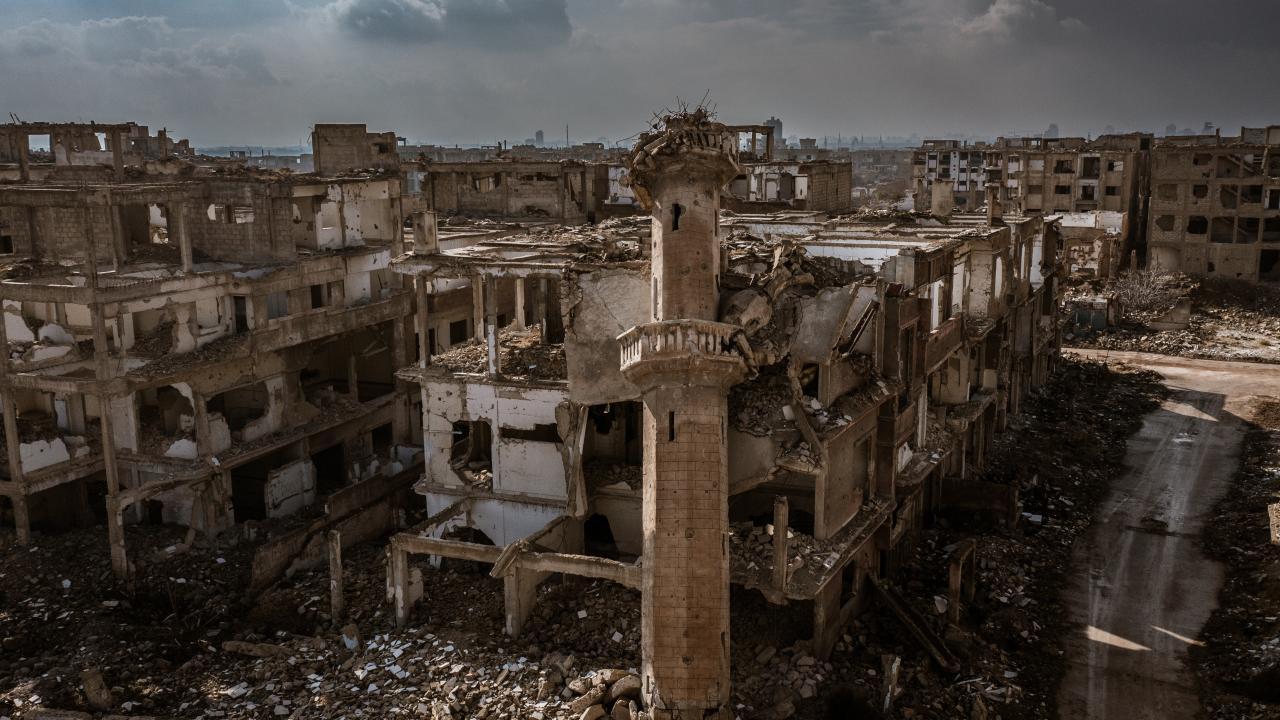
The Witness of the Silent Minaret – The Ruins of Hama (TRT News)
Syria, which gained independence from France in 1946, entered a political path marked by coups and internal conflicts after a brief constitutional period. In 1963, the Arab Socialist Baath Party seized power and established a one-party regime. The “Neo-Baath” era, beginning with Hafez al-Assad’s bloodless coup in 1970, produced a governance model that blended the state’s secular nationalist ideology with a sectarian authoritarian structure. The regime largely placed members of the Alawite minority in top state positions, a situation that generated widespread discontent among the Sunni majority.
Among the cities most affected by this transformation, Hama preserved its religious conservative identity for decades and became the strongest stronghold of the Muslim Brotherhood. Political tensions that began in the 1970s reached their peak with the 1979 Aleppo Artillery School massacre. The regime used this act as justification to launch a full-scale war against the Brotherhood, and in 1980, Law No. 49 declared membership in the Muslim Brotherhood punishable by death.
In early 1982, a new wave of uprising led by the Muslim Brotherhood erupted in Hama. In response, Hafez al-Assad ordered the city’s complete destruction as a warning to the world, placing command of the operation under his brother Rifaat al-Assad. A force of 20,000 troops composed of the Defense Brigades, Special Forces, the 21st Mechanized Division, the 21st Airborne Regiment, General Intelligence, and paramilitary Shabiha units was deployed. Before the siege, water, electricity, and communication lines were cut, isolating the city entirely from the outside world.
The assault, initiated with aerial bombardment, continued with intense artillery fire. Tanks and infantry units then entered the city’s neighborhoods, systematically destroying Hama.
The attacks lasted for 27 days, with particular focus on neighborhoods such as as-Sahhane, al-Kilayniyye, al-Asida, al-Bashuriyye, az-Zenbakiyye, and al-Hayriyye. Seventy percent of the city’s mosques, three churches, and numerous historical structures were destroyed; schools, factories, mosques, and public buildings were converted into temporary interrogation and execution centers.
According to international human rights organizations, at least 30,000 civilians were killed in the massacre. Some sources estimate the number approached 40,000. More than 17,000 people were arrested and subsequently disappeared; it is believed that a large portion were taken to Tadmur Prison, where they were systematically tortured to death.
Eyewitnesses reported that soldiers executed civilians at random, slit the bellies of pregnant women to kill unborn babies under the pretext that they were “terrorists,” committed widespread rape against women, and shot children dead in the streets. Bodies were often burned in groups or thrown into the Orontes River, while others were buried in mass graves.
Children who survived the massacre grew up orphaned, forced to cope with social exclusion, poverty, and psychological trauma. Those who managed to flee Hama mostly migrated to neighboring countries and the West, forming the first core of the Syrian diaspora.
After the Hama Massacre, the regime pursued a strategy of denial both domestically and internationally. The name “Hama” was omitted from official documents, school textbooks, and news bulletins. The massacre was encoded in public memory as merely “the Events” (al-ahdath). Even the word “Hama” became banned in Syria.
The Hama Massacre was viewed by the international community not only as a punitive operation but also as part of a broader strategy of social engineering. The regime physically altered the city’s landscape, changing its demographic composition and replacing opposition neighborhoods with Baath Party buildings and luxury hotels. The city was economically punished to ensure it would never rise again, combining physical destruction with the deliberate erasure of social and symbolic memory.
The international community’s reaction during the massacre was extremely muted. Western states avoided intervening in what they labeled Syria’s “internal affair.” Iran’s stance during this period was particularly notable. At the time, Iran was at war with Iraq under Saddam Hussein. Syria’s support for Iran was not left unreciprocated; the Tehran regime strengthened its ties with the Assad regime by remaining silent on the Hama Massacre. This dynamic was interpreted by political analysts as evidence that Iran’s regional expansionist strategy prioritized political interests over sectarian considerations.
For the Syrian regime, the Hama Massacre was not merely a military victory but a paradigm shift in governance. The state began to treat violence not as a security reflex but as a tool of political control. After this event, organized structures of political Islam were nearly eradicated within the country. In the absence of political opposition, the Baath regime maintained its absolute authority for decades.
During the popular uprisings in Syria in 2011, influenced by the Arab Spring, the people of Hama once again took to the streets—not only to protest the Bashar al-Assad regime but also to demand accountability for 1982. Slogans such as “The blood of Hama will not remain on the ground” were frequently heard in the city’s streets. Thus, the anger and desire for justice suppressed in 1982 resurfaced 30 years later.
The 1982 Hama Events are regarded as one of the most extensive and controversial security operations in modern Syrian history. The events in Hama were presented by the Syrian regime of the time as a military intervention necessary to ensure state security and stability. However, the massive civilian casualties during the operation led many to interpret it not merely as a security operation but as a pivotal moment with profound social, cultural, and political consequences. The international community’s limited response contributed to the event remaining off the regional and global public agenda for many years.
Following 2011, the surge in social mobilization and political transformation in Syria triggered a revival of historical memory surrounding the Hama Events. This demonstrates that social traumas can continue to exert influence not only within historical contexts but also within contemporary political crises. In this context, Hama has become more than a geographical settlement; it has transformed into a symbol representing the Syrian society’s—and the broader regional collective memory’s—demands for justice, truth, and political representation. Remembering and investigating the event is as important for understanding the past as it is for preventing similar human rights violations in the future.
Al Jazeera Türk. "Suriye: Hama’nın 30 Yıl Sonra Gelen İntikamı." Al Jazeera Türk, February 3, 2012. Accessed March 23, 2025.https://www.aljazeera.com.tr/gorus/suriye-hamanin-30-yil-sonra-gelen-intikami.
Anadolu Ajansı. "Hama Katliamına 1982'de Tanıklık Eden Çocuklar Kimsesiz Kalmanın Acısıyla Büyüdü." Anadolu Ajansı, February 2, 2024. Accessed March 23, 2025.https://www.aa.com.tr/tr/dunya/hama-katliamina-1982de-taniklik-eden-cocuklar-kimsesiz-kalmanin-acisiyla-buyudu/3482868
Anadolu Ajansı. "Hama Katliamının Tanığı Aziz Şahit Olduğu Vahşeti Unutamıyor: Askerler Doğmamış Bebekleri ‘Terörist’ Diyerek Öldürüyordu." Anadolu Ajansı, March 23, 2021. Accessed March 23, 2025.https://www.aa.com.tr/tr/dunya/hama-katliaminin-tanigi-aziz-sahit-oldugu-vahseti-unutamiyor-askerler-dogmamis-bebekleri-terorist-diyerek-olduruyordu/2155175
Danış, Mehmet Fahri. "1976–1982 Kalkışması ve 2011 Suriye Olaylarına Yol Açan İçsel Dinamiklerin Karşılaştırılması." Uluslararası İlişkiler Çalışmaları Dergisi 1, no. 1 (2021): 28–45.
Fikri Mecra. "Hama Katliamının Acısı Dinmiyor." GZT, February 3, 2021. Accessed March 23, 2025.https://www.gzt.com/mecra/hama-katliaminin-acisi-dinmiyor-3568219
Güçtürk, Yavuz. İnsanlığın Kaybı: Suriye’dekiİç Savaşın İnsan Hakları Boyutu. Ankara: SETA Yayınları, 2014.
TRT Haber. "Baas Rejimi Döneminde Adı Dahi Anılamayan Hama Katliamının Üzerinden 43 Yıl Geçti." TRT Haber, February 2, 2025. Accessed March 23, 2025.https://www.trthaber.com/haber/dunya/baas-rejimi-doneminde-adi-dahi-anilamayan-hama-katliaminin-uzerinden-43-yil-gecti-896419.html
TRT Haber. "Bir Şehir Anlatıyor: Hama." TRT Haber, February 2, 2023. Accessed March 23, 2025.https://www.trthaber.com/haber/dunya/bir-sehir-anlatiyor-hama-890727.html.
Ulutaş, Ufuk, and Selin M. Bölme, eds. Kim Kimdir? Suriye’de Aktörler: Rejim, Muhalefet, Dini Yapı ve Medya. Ankara: SETA Yayınları, 2012.
Yeni Şafak. "Eski Hamalardan Yeni Hamalara." Taha Kılınç, July 7, 2020. Accessed March 23, 2025.https://www.yenisafak.com/yazarlar/taha-kilinc/eski-hamalardan-yeni-hamalara-2035966.
Yeni Şafak. "Hamayı Yeniden Hatırlamak." Akif Emre, July 7, 2014. Accessed March 23, 2025.https://www.yenisafak.com/yazarlar/akif-emre/hamayi-yeniden-hatirlamak-30997
İHH İnsani Yardım Vakfı. "Hama Katliamının 28. Yılında." İHH, February 3, 2010. Accessed March 23, 2025.https://ihh.org.tr/haber/hama-katliaminin-28-yilinda-276

Name of the Incident | 1982 Hama Massacre | ||||||||
|---|---|---|---|---|---|---|---|---|---|
Date | 2–28 February 1982 | ||||||||
Location | Hama/Syria | ||||||||
Type of Incident | Religious-Based Suppression State Violence Crime Against Humanity City Siege Massacre | ||||||||
Responsible Parties | Special Forces Paramilitary Shabiha Elements Intelligence Units Syrian Army Operation Commander Rifaat al-Assad (Defense Brigades) President Hafez al-Assad Syrian Arab Republic (Ba'ath regime) | ||||||||
Targets | Civilian population (particularly Sunni conservatives) Members of the Muslim Brotherhood Organization (Ikhwan) | ||||||||
Estimated Scale of the Massacre | Number of deaths: At least 30,000 Lost: At least 17,000 people Destroyed structures: Approximately 88 mosques - 3 churches - dozens of historical and civilian buildings Destroyed part of the city: Approximately one-third of the city center | ||||||||
Historical and Political Background
Preparation for the Massacre and Military Operation
Course and Scale of the Massacre
Testimonies and Human Drama
After the Massacre: Silence and Suppression of Memory
International Silence and Geopolitical Equilibriums
Political and Sociological Consequences
2011 and Beyond