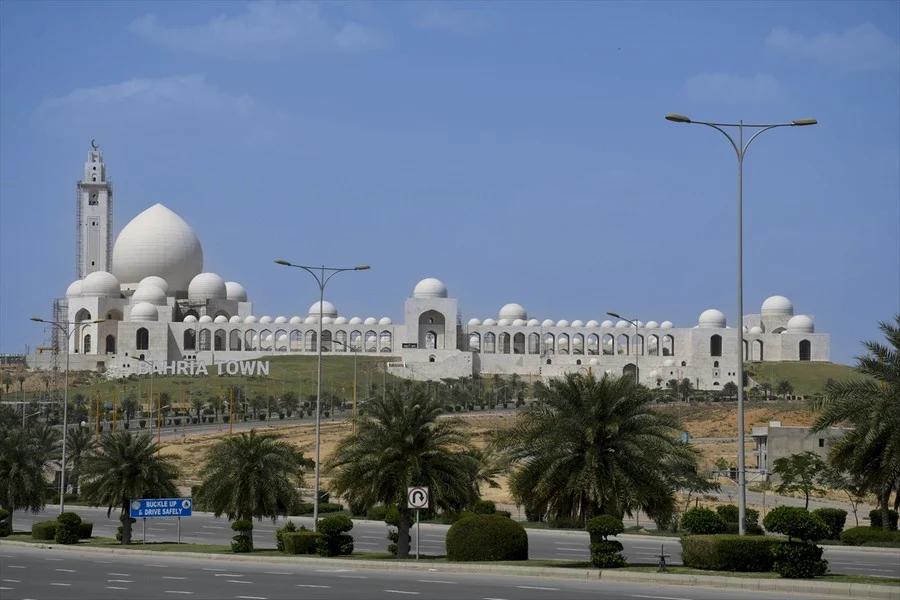


Jamia Ulu Camii
🕌 This mosque, located in Bahria Town, Lahore, holds the title of Pakistan’s largest mosque and is the seventh largest mosque in the world. It can accommodate 25,000 worshippers in its main hall and up to 70,000 people simultaneously in total. Although some sources mention even higher capacities for similar projects in Pakistan such as 800,000, this structure in Lahore continues to amaze everyone with its grandeur.
✨ Architectural Features and Enchanting Details
The mosque’s design is filled with intricate details that spark the imagination of young visitors and students:
- 🔴 Domes and Minarets: The mosque has exactly 21 domes. The central dome at the top appears like a magnificent crown surrounded by 20 smaller domes. Additionally, it features four large minarets, each approximately 50 metres (165 feet) high.
- 🔵 Millions of Tiles: The interior halls are adorned with a stunning 4,000,000 mosaic tiles. The white chandeliers and handcrafted frescoes (wall paintings) lend the mosque a fairytale atmosphere.
- 🟢 Magical Acoustics: The pulpit is designed with a special acoustic system that projects sound throughout the entire building. Sound from the pulpit travels through the domes and converges at the central dome, ensuring it is clearly audible to everyone.
- 🟠 Orange Bricks: The specially colored orange sandstone bricks used in the courtyard were brought from the city of Multan.
🎓 A Learning Center for Children: Islamic Academy
Did you know that the mosque is not only a place of worship but also a modern school for children and youth? Located in the basement of the mosque, the Islamic Academy is a state-of-the-art institution offering both religious and modern education.
The academy includes:
- 📖 23 classrooms and 4 faculty rooms.
- 📚 A library for student research.
- 🧪 Two laboratories for experiments and studies.
- 🎤 An auditorium and multipurpose hall for large events.
- 🎨 Additionally, an Islamic art gallery is located on this floor.
🌳 Enchanting Gardens (Chahar Bagh)
The courtyard of the mosque was designed with inspiration from Persian, Central Asian and Indian styles. The traditional Persian garden layout known as Chahar Bagh divides the square garden into four sections with walking paths, centered around a beautiful fountain. This arrangement imparts a serene natural atmosphere to the mosque.