

`hardness` Related Article Results
Precipitation Hardening
Precipitation hardening is a heat treatment method used to enhance the mechanical properties of alloys. This technique is based on the principle of forming second-phase particles (precipitates) within the alloy matrix by first dissolving the alloy at high temperature, rapidly quenching it (e.g., in water), and then holding it at a specific temperature (aging). Precipitates significantly increase the material’s yield and tensile strength by impeding dislocation motion during deformation. Historic
EN
Muzaffer Yalçın
 Ha
HaHardness Tests
Hardness is defined as a material’s resistance to plastic deformation. This property is typically measured by the material’s response to a permanent shape change induced by a force applied to its surface. Although hardness does not fully reflect all mechanical properties of a material, it provides indirect information about important performance criteria such as wear resistance, durability, and surface quality. In materials science and engineering, the hardness value is one of the fundamental pa
EN
Sıla Başköylü

DLC (Diamond-Like Carbon) Coating
Diamond-like carbon (DLC) is a type of coating belonging to the class of amorphous carbon films and contains both sp² and sp³ hybridized carbon bonds. Structurally, DLC combines diamond-like properties such as high hardness and chemical inertness with graphite-like characteristics including exceptional lubricity and low coefficient of friction. This structural versatility enables DLC to be used in optical, mechanical, tribological, and biomedical applications. DLC films are classified based on t
ENMuzaffer Yalçın
PVD Coating
Physical Vapor Deposition (PVD) is a coating technology based on the physical vaporization of a solid target material and its transport to a substrate surface, where it condenses to form a thin film coating. This method is typically carried out under high-temperature and low-pressure conditions. The vaporized atoms or molecules condense upon reaching the substrate, forming the desired coating layer. Throughout the process, material transfer occurs entirely through physical mechanisms; no chemica
ENMuzaffer Yalçın
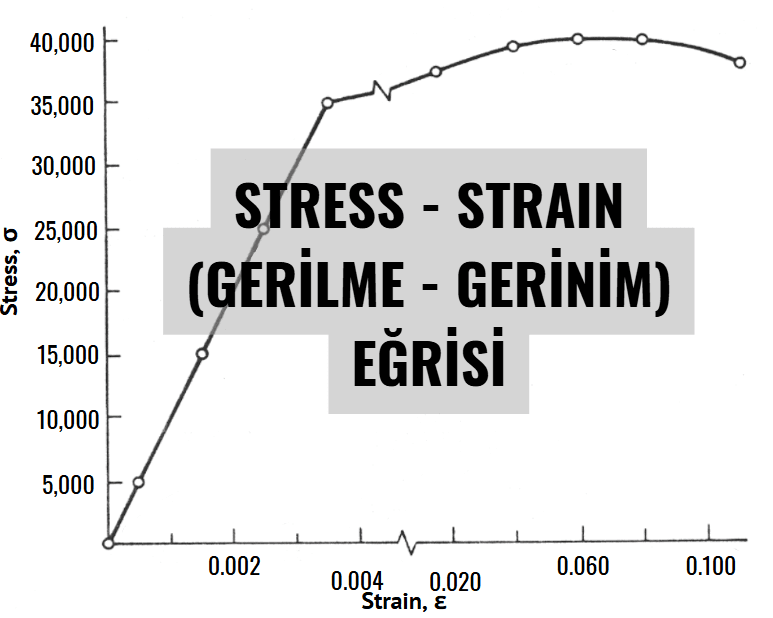
Stress-Strain Curve
Stress-Strain Curve is one of the fundamental graphical tools used to characterize the mechanical behavior of a material. This curve defines the relationship between the applied external force (stress) and the resulting deformation (strain). In materials science and engineering, it holds central importance in evaluating elastic, plastic, and fracture behaviors. Purpose of Use Stress-strain curves enable the determination of parameters such as the elastic limit, melting point, fracture strain, du
ENMuzaffer Yalçın