

`calculation` Related Article Results
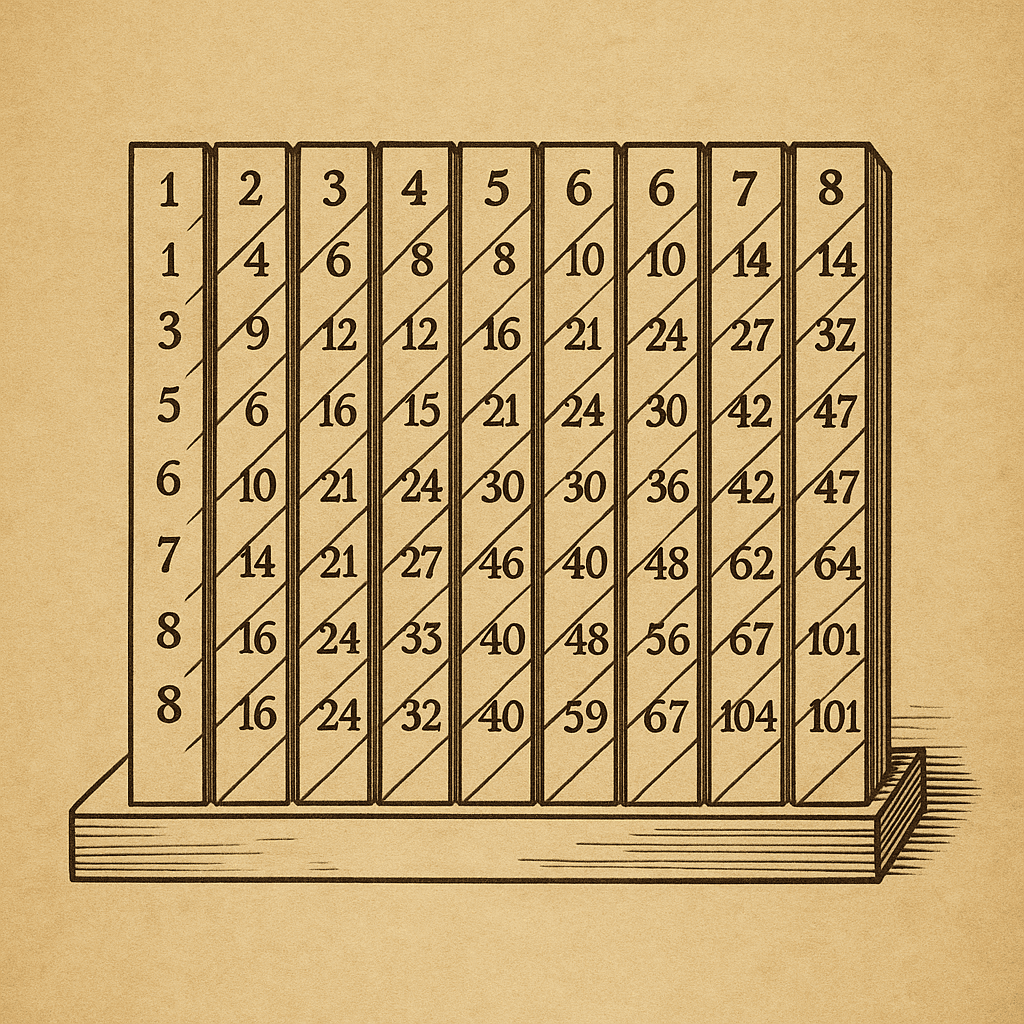
Napier's Bones
Napier’s Bones is a calculating device developed in the early 17th century by Scottish mathematician John Napier. Designed primarily to simplify multiplication and division operations, it is regarded as one of the earliest examples of mechanizing mathematical calculations. Napier’s invention was among the tools developed in the pre-computer era to accelerate mathematical operations and reduce error rates. Napier lived between 1550 and 1617 and is best known for his discovery of logarithms. Howev
EN
Samet Şahin
 Sl
SlSliding Ruler
Slide rule is a mechanical analog calculator based primarily on the principle of logarithms. Before the widespread adoption of electronic calculators, it was a fundamental tool used especially in science and engineering for performing multiplication, division, root extraction, exponentiation, and various trigonometric functions. Its structure consists of logarithmically scaled rulers that move relative to each other and a movable cursor (also called a slide or indicator) that enables alignment b
EN
Yunus Emre Yüce
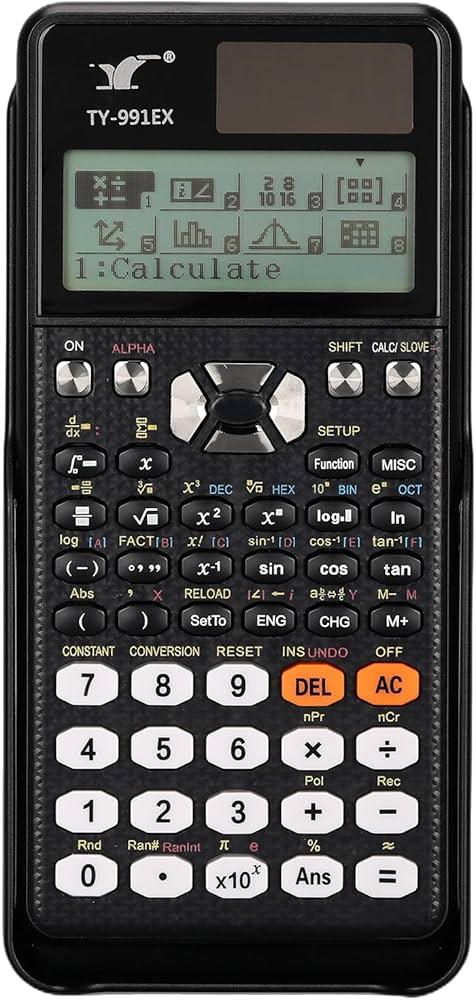
Calculator
A device designed to perform mathematical operations, either electronic or mechanical. Basic models carry out the four fundamental arithmetic operations—addition, subtraction, multiplication, and division like—while advanced scientific and graphic account calculators trigonometry, logarithm support complex functions such as statistical calculations and even graphical boot. History of Calculators In ancient times, counting boards such as the abacus were used for calculations. It is believed that
EN
Muhammed Erdem