

`aristotle` Related Article Results

Short History of Philosophy (Book)
Nigel Warburton’s A Short History of Philosophy is a history of philosophy that presents the approximately 2400-year development of Western philosophy in a clear, systematic, and accessible style. First published in 2001, the book introduces readers to a broad intellectual tradition stretching from Socrates to Peter Singer, presenting the evolution of philosophical thought in chronological order. It is structured to appeal both to academic audiences and to readers new to philosophy. Structure an
EN
Meryem Beyza Utkulu

Ancient Philosophy
Ancient philosophy (Pre-Socratic Philosophy) refers to philosophical thought spanning approximately from the 6th century BCE to the 6th century CE, forming the roots of Western intellectual history. This period encompasses systematic modes of thought developed primarily within the frameworks of ancient Greek and Roman civilizations. Ancient philosophers questioned fundamental issues such as the nature of the universe, the source of knowledge, the foundation of ethics, and the purpose of human li
EN
Esra Can
 By
ByByzantine Philosophy
Bizantine philosophy refers to the unique form adopted by the Greco-Roman philosophical heritage as it merged with Christianity over a period of approximately one thousand years within the geographical boundaries of the Eastern Roman Empire (Byzantium). This philosophical tradition is not merely the copying and preservation of classical philosophical texts; it is also an intellectual domain in which these texts were reinterpreted at theological, ethical, logical, and metaphysical levels. Bizanti
EN
Aslı Öncan

Aristotle
Aristotle, or simply Aristotle, was a renowned philosopher and sage who lived in ancient Greece in very distant times. A philosopher is someone who seeks to understand life, nature, and humanity. Aristotle was curious about many subjects: the sky, animals, cities, and even how people achieve happiness… Have you ever tried different approaches while searching for an answer to a question? Aristotle did exactly that: he began to think by asking, “How can I understand this?” Childhood and Education
EN
İbrahim Mert Akbaş
FaFallacies
Fallacies are erroneous inferences that arise in logical thought and reasoning execution processes. These concept refer to forms of reasoning that appear misleading or reasonable like but are in fact invalid. Throughout history, fallacies have been studied in the fields of philosophy, logic, and rhetoric, and have been used consciously or unconsciously to manipulate thoughts or lead people to erroneous conclusions. The first systematic examination of fallacies was conducted by Aristotle in his w
EN
Esra Can
ArAristotle's Four Causes Principle
Aristotle’s (384–322 BCE) four causes principle (or four causes theory) is one of the foundational pillars of his philosophy, particularly in metaphysics and natural philosophy. This principle systematically identifies four distinct types of explanation necessary to fully understand what something is, how it exists, and why it exists. According to Aristotle, genuine and complete knowledge (epistêmê) of a thing is possible only when we know its cause or causes (aitia). Thus, the Four Causes const
EN
Yunus Emre Yüce
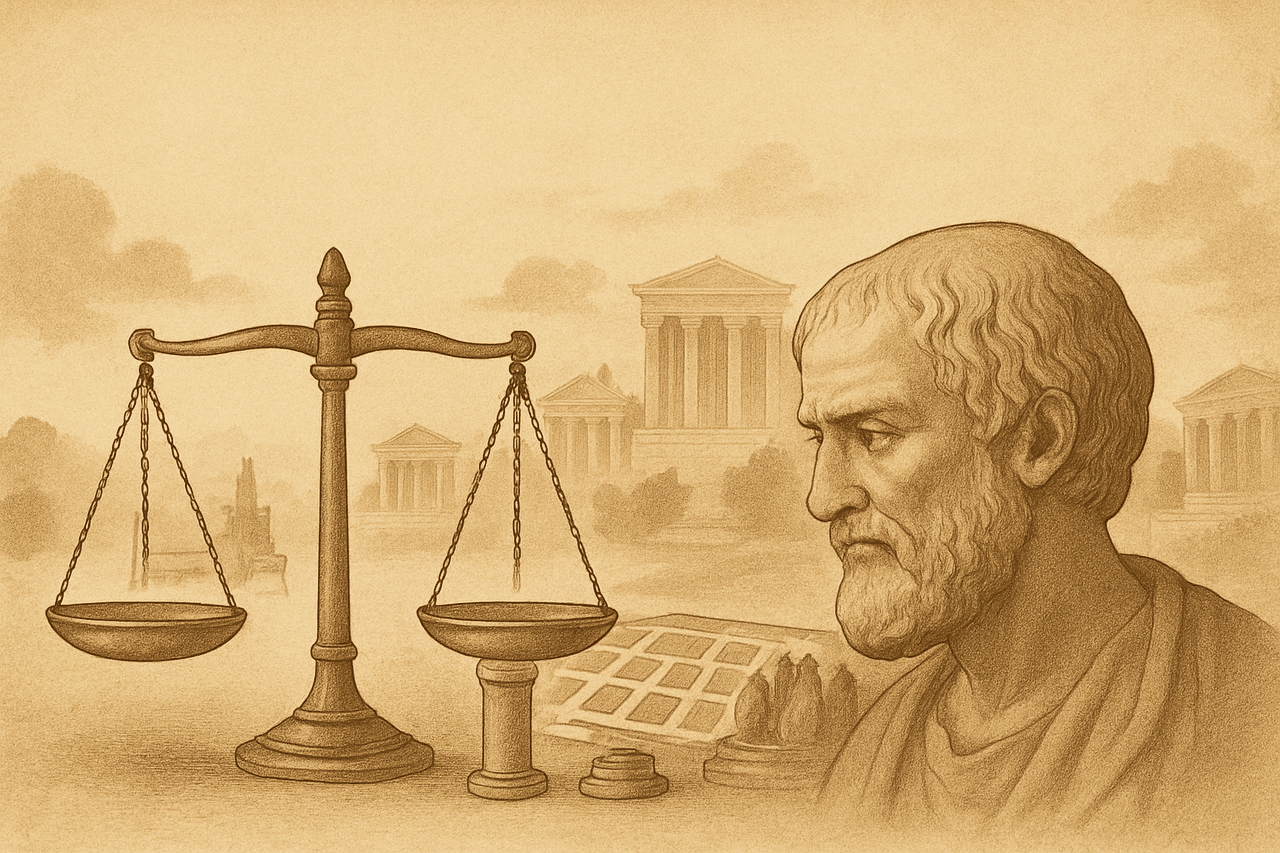
Aristotle's Concept of the Politeia
Politeia is a multifaceted concept in Aristotle’s political philosophy, denoting both “constitution” and “form of government.” Derived from the Ancient Greek term “polis” (city-state), politeia defines a society’s political organization, the relationship between rulers and ruled, and the structure of citizenship. For Aristotle, politeia is not merely a model of governance but the political structure of a society organized according to the principles of virtue, balance, and law. Place and Definit
EN
Azra Ece Güney

Ancient Philosophy
Ancient philosophy (Pre-Socratic Philosophy) refers to philosophical thought spanning approximately from the 6th century BCE to the 6th century CE and forms the roots of Western intellectual history. This period encompasses systematic modes of thought developed primarily within the contexts of ancient Greek and Roman civilizations. Ancient philosophers critically examined fundamental questions regarding the nature of the universe, the source of knowledge, the foundation of ethics, and the purpos
ENEsra Can