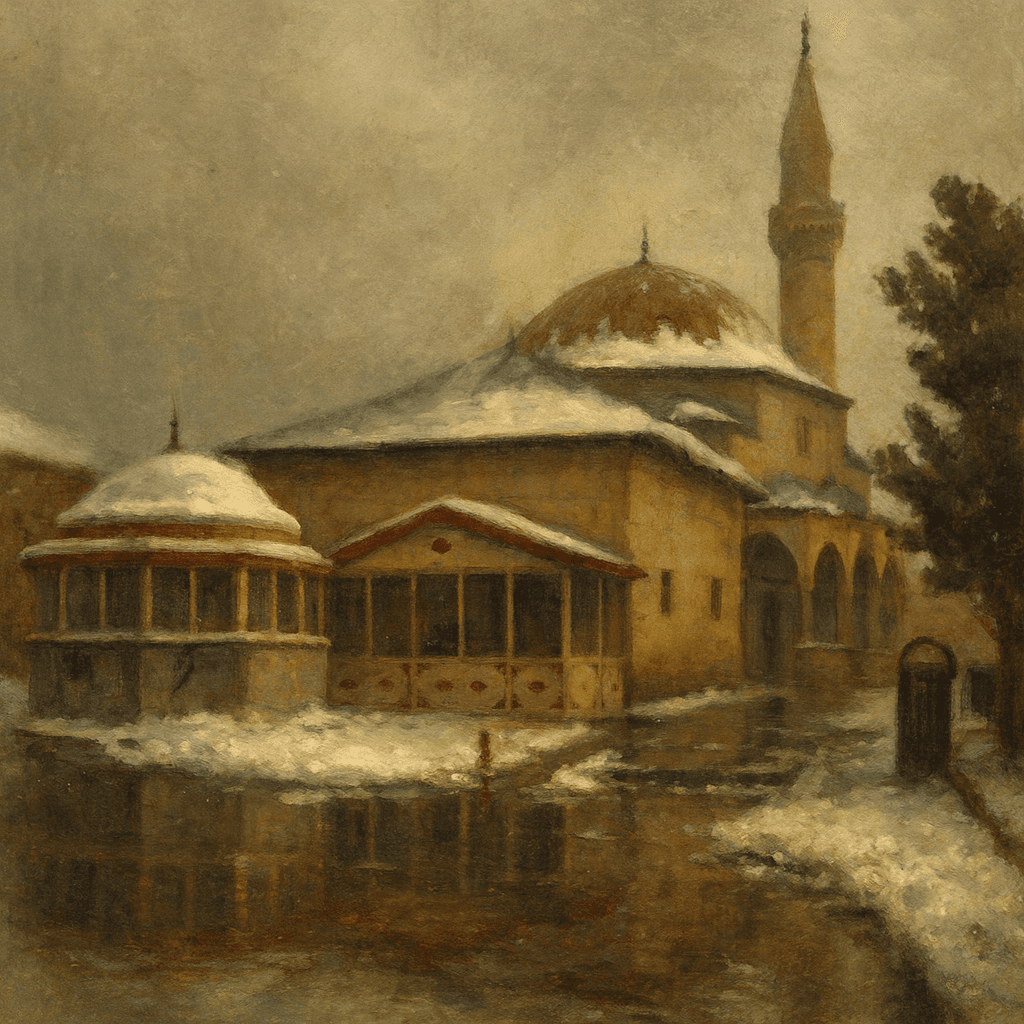


Tomb of Abdurrahman Gazi
Rising at the foothills of Palandöken Mountain in the southeast of Erzurum, the Abdurrahman Gazi Türbesi is one of the city’s most renowned pilgrimage sites. It is widely believed among the people that the person buried here was the standard-bearer of the Prophet Muhammad. For this reason, the tomb is regarded as a sacred place not only by locals but also by visitors from surrounding provinces. Over time, the area around the tomb was planted with trees and transformed into a recreational space, making it a preferred destination for both rest and prayer.
(Generated by Artificial Intelligence)
Historical Background
The name Abdurrahman Gazi first appears in Ottoman archival records in 1529, where he is described as “the standard-bearer of the Prophet.”
The current tomb was built in 1796 by Ayşe Hanım, the wife of Erzurum Governor Yusuf Ziya Pasha. A mosque was also constructed beside it. Above the tomb’s entrance is an inscription dated 1796, written by the calligrapher Salim. Inside the tomb lies the mausoleum of Abdurrahman Gazi, which measures exactly 4.85 meters in length. It is said that this unusual length was designed to symbolize his spiritual greatness and to allow visitors to pray comfortably.
Legends and Traditions
Numerous legends and traditions surround Abdurrahman Gazi, offering varying perspectives on his identity and life:
- According to some accounts, he was the son of Abu Bakr.
- Other sources state that he was a Muslim commander named Habib ibn Maslama, who came to Erzurum under that name and later became known as “Abdurrahman Gazi.”
- Evliya Çelebi describes the site of Abdurrahman Gazi’s tomb as “a mountain filled with fragrant scents and home to healing herbs.”
Some of the most widely known local traditions include:
- Near the tomb is a grave believed to belong to Abdurrahman Gazi’s brother. Several tombs have been built over this grave, but each was destroyed and left open. The people interpret this as a sign of the brother’s humble and unassuming spirit, who did not seek grandeur.
- According to tradition, Ibrahim Hakkı Hazretleri discovered the grave of Abdurrahman Gazi through spiritual insight and commissioned the rebuilding of the tomb.
- Some legends trace the origin of Erzurum’s 1001 Hatim tradition to Abdurrahman Gazi’s dervish lodge, where dervishes served the community and offered food and drink to visitors.
(Generated by Artificial Intelligence)
Significance of the Tomb
Abdurrahman Gazi is regarded as one of the leading figures in the Islamization of Anatolia. His name is remembered among the people of Erzurum in connection with martyrdom and valor, and he has become a spiritual hero in collective memory.
Today, the tomb serves as both a religious and cultural gathering point. People come here to pray, hold picnics around its grounds, and connect with the city’s history. Thus, the tomb has become a living tradition that preserves the past while remaining active in the present.