Datça (District)
Imagine this: on one side, the deep blue Aegean Sea; on the other, the endless Mediterranean... Hidden at the very tip of Türkiye, where these two great seas meet, lies a hidden gem: Datça Peninsula! This is a wonderful natural corner waiting to be discovered, with its pristine air and ancient stories.
Where is Datça?
Datça is a charming town in the southwest of Muğla, Türkiye. Seen from land, it resembles a long, slender finger. One side of this “finger” is washed by the Aegean Sea, while the other is bordered by the Mediterranean.
This is a peninsula—a landmass surrounded by water on three sides but connected to the mainland on one. Datça is so long that traveling from one end to the other covers approximately 64 kilometers.
Datça’s Famous Trio: Honey, Almond, and Fish
Whenever Datça is mentioned, three famous things beginning with the letter “B” come to mind: honey, almond, and fish.
- Almond: Türkiye’s most delicious almonds are grown here. In February, when the trees burst into pure white blossoms, the entire landscape resembles a cotton field.
- Honey: Bees collect nectar from Datça’s fragrant thyme flowers to produce some of the world’s most unique honeys.
- Fish: The sea is so clean that its fish are exceptionally fresh and diverse.
Journey to the Past: The Ancient City of Knidos
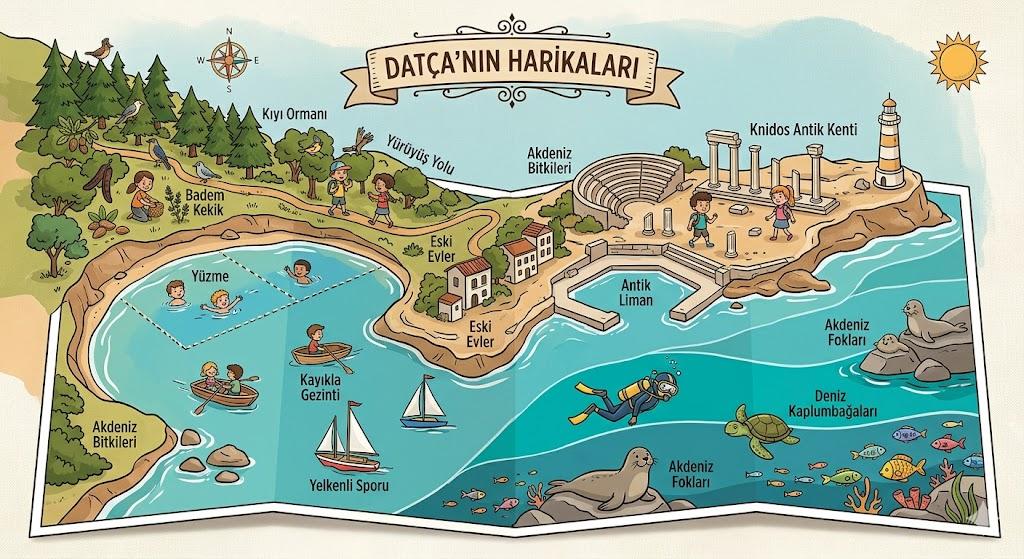
At the farthest tip of Datça, at Tekir Burnu, lies an ancient city known as Knidos. Thousands of years ago, the people who lived here built structures to study the heavens and constructed large harbors for sailors.
Imagine this: without electricity, the inhabitants of Knidos measured time using a massive sundial! Famous sculptors and scientists also lived in this city, leaving behind remarkable works of art and knowledge.

Datça (Generated by artificial intelligence.)
Why Is There So Much Wind?
While walking in Datça, you will constantly encounter a gentle breeze that lifts your hair. Thanks to this wind, the air never becomes overly stifling, even in summer. In the past, people built enormous windmills on the hills to harness this wind. Today, you can still see these historic windmills in the village of Kızlan.