

Çıldır (District)
Çıldır is a district of Ardahan province in Türkiye, with a very ancient history and captivating natural wonders. Have you ever imagined walking across a vast, completely frozen lake? Çıldır is a unique place that offers you exactly this magical experience in winter, while in other seasons it awaits you with lakes teeming with flying birds.
Where is Çıldır and What Is Its Geography?
Çıldır is located in the northeast of Türkiye, at the point where Ardahan and Kars provinces meet. The district is built on a flat area with an average elevation of 1950 metres, surrounded by mountains named Keldağ and Gökdağ, which reach heights of up to 3000 metres.【1】
Rivers named Kura and Karasu flow through the district’s territory. Additionally, the district is home to two very important lakes: one is the famous Çıldır Lake, which freezes completely, and the other is Aktaş Lake, half of which lies within the borders of the neighbouring country Georgia.
Winter Adventure on Çıldır Lake
Çıldır Lake is the second largest lake in the Eastern Anatolia Region after Van Lake and the largest freshwater lake in the region. The lake is beautiful in every season, but its true magic emerges when it begins to freeze from the second week of December.
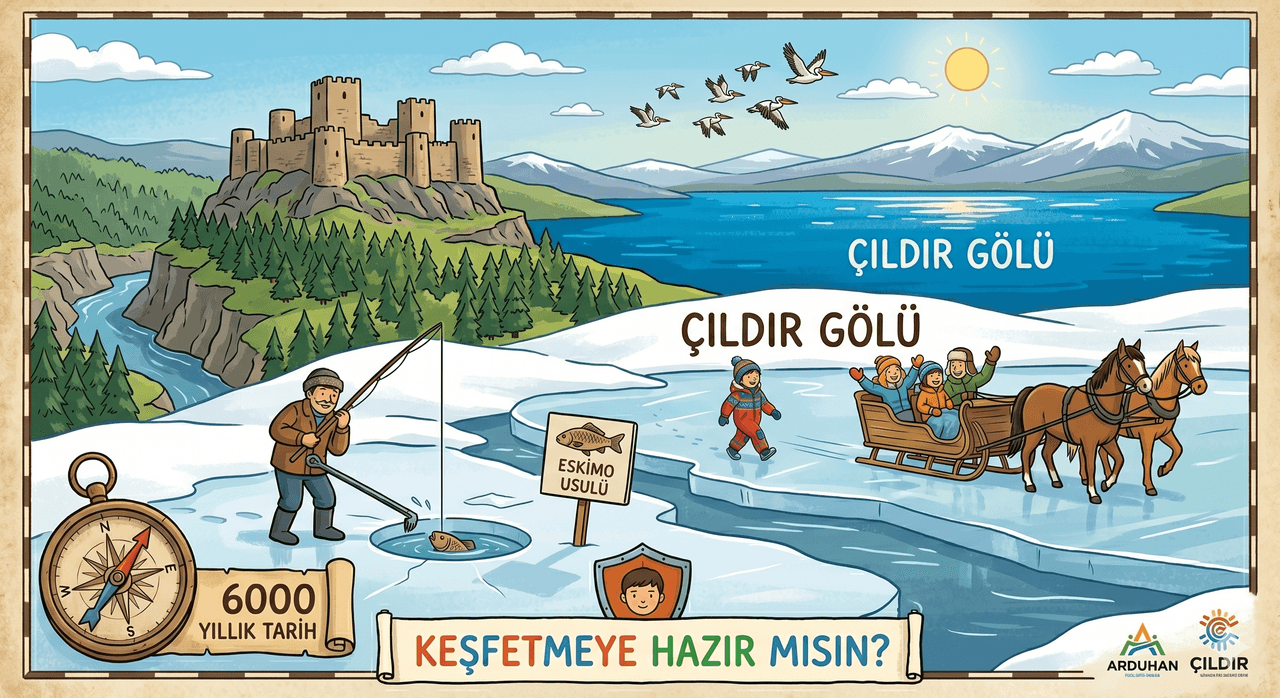
During January, February and March, the lake becomes entirely frozen. The ice thickness reaches such high levels that people can safely walk on its vast ice surface and even enjoy cheerful sleigh rides with horses. In winter, a colourful illuminated “Ice City” is also built in this region, featuring ice towers, green caves made from the needles of pine trees, and fruit museums.

Çıldır Lake (Generated by Artificial Intelligence)
“Eskimo-Style” Fishing on the Lake
When winter temperatures in Çıldır Lake drop below minus 15 degrees Celsius, the ice thickness exceeds 80 centimetres. One of the most fascinating activities during this time is “Eskimo-style” ice fishing. Fishermen break the thick ice using picks, shovels and even saws.
They catch the region’s beloved carp from beneath the ice. When engaging in this enjoyable activity, it is essential to wear thick clothing such as snow pants, snow jackets, hats, sunglasses and gloves to protect against the strong winds.
A Safe Nest for Birds: Aktaş Lake
Aktaş Lake, another natural wonder in the district, contains twelve small uninhabited islands. These islands are covered with grasslands and reed beds, making them a safe haven for migratory birds.
Because Aktaş Lake lies within a military zone, bird species such as the Dalmatian pelican, velvet duck, coot and heron can nest and live freely without any threat. This area has been placed under protection by a special regulation to preserve the birds.
The Secret in the Mysterious Valley: Şeytan Kalesi
We usually think of castles as being built on the summits of high mountains or to defend cities. However, the Şeytan Kalesi in Çıldır is very different from others. This medieval castle is built on a steep peninsula surrounded on three sides by the Karaçay River, nestled within a narrow valley.
The castle’s name is known to derive from the Old Turkish words “alviz” or “albız,” meaning “demon.” With walls reaching up to two metres in height and its hidden location, it has served as a stronghold for many great civilizations throughout history, including the Medes, Persians, Romans, Seljuks and Ottomans.

Steep Cliffs (Generated by Artificial Intelligence)
Time Travel
Çıldır is one of Türkiye’s oldest Turkish settlements, with a history stretching back 6000 years. The Saka Turks arrived here between 650 and 700 BCE. The district’s name originates from the “Çavuldur” tribe, a lineage descended from Oğuz Han. Even the famous Sultan Alp Arslan visited Çıldır with his army before his 1071 victory and was hosted here for three days. After remaining under the control of various states for many years, the region was liberated from foreign occupation and reintegrated into the homeland on 25 February 1921.【2】
Citations
[1]
Ardahan Valiliği, “Çıldır,” accessed 15 May 2026, https://www.ardahan.gov.tr/cildir.
[2]
Çıldır Kaymakamlığı, “Tarihçe,” accessed 15 May 2026, https://www.cildir.gov.tr/tarihce.