

Celsus Library
Celsus Kütüphanesi is a magnificent and captivating library built thousands of years ago in the ancient city of Ephesus. What do you say about exploring this grand structure, where information once stored on scrolls is now read from tablets or computers?
Who Built This Library and Why?
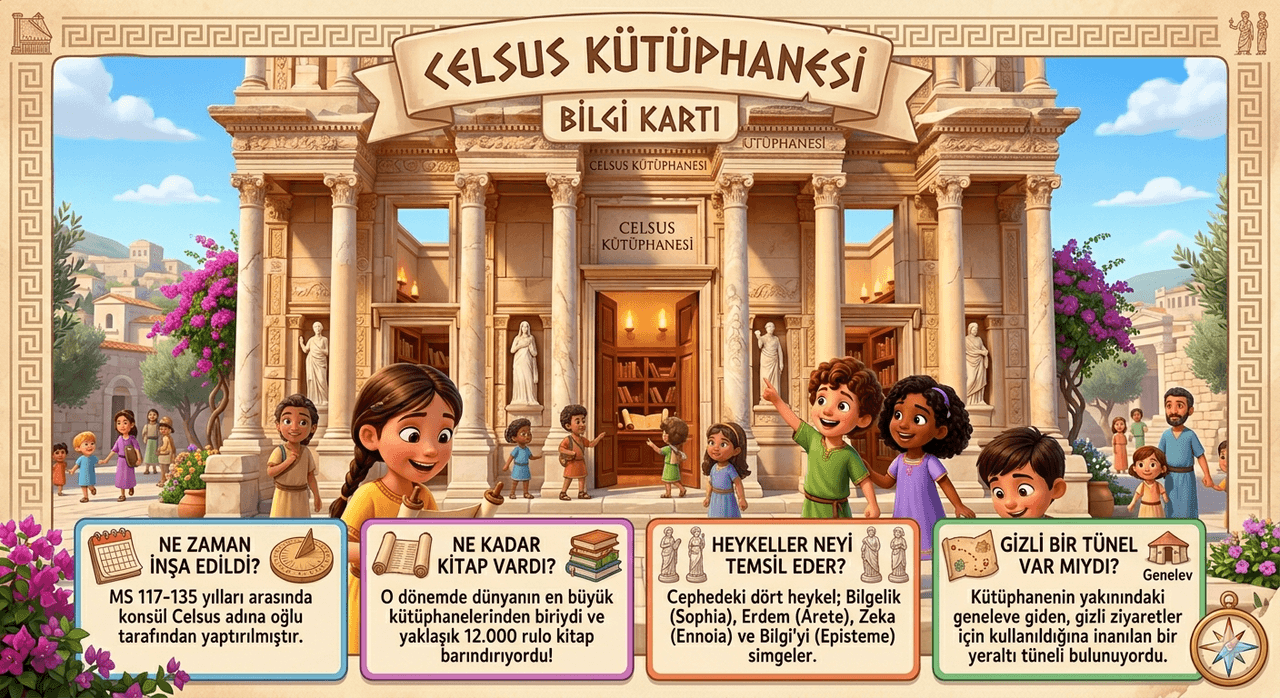
Long ago, a son named Gaius Julius Aquila decided to commission this magnificent building in memory of his father, Celsus, after his death. Construction of the library was completed around AD 110–135. This structure was not merely a library; it also served as a special monument housing Celsus’s tomb. Thus, Celsus, the founder of the library, lies buried directly beneath the very books he loved.
The Grand Entrance and Statues of the Library
To enter the library, you must first ascend a wide marble staircase with nine steps. At the entrance, you are greeted by four magnificent female statues, each representing an important ideal:
- Sophia: Wisdom and Intellect.
- Arete: Virtue and Character.
- Ennoia: Thought and Reason.
- Episteme: Knowledge and Science.
In ancient times, it was expected that those who entered the library possessed these four noble qualities.
What Was Inside the Library?
It is estimated that the library once held approximately 12,000 scroll books. At that time, texts were not bound like modern books but stored as long scrolls. To protect the scrolls from moisture and decay, the Ephesians devised an ingenious method: they constructed the library walls in two layers. The space between the walls acted like a thermos, preserving dry air inside and keeping the scrolls preserved.
Where Is the Celsus Library?
This magnificent structure is located at the very center of Ephesus Ancient City, in the Selçuk district of İzmir, a site visited by millions each year. The library is a priceless treasure listed on UNESCO’s World Heritage List.