Halfeti (District)
What would you think if we told you that a city lies beneath the waters and black roses bloom there? Şanlıurfa’s beautiful district of Halfeti, with its unique natural beauty and mysterious submerged history, will amaze you. Let us explore this fairytale place together!
Where Is the Hidden City Beneath the Waters?
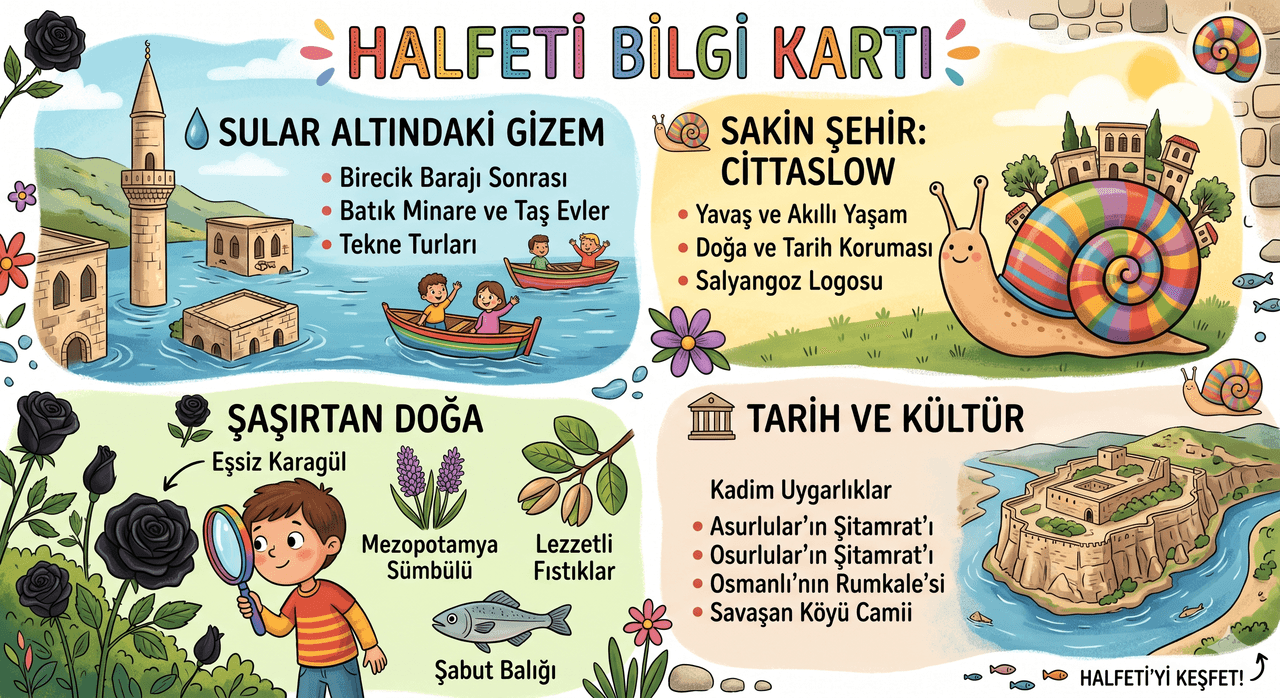
Halfeti is an ancient and exceptionally unique settlement located in southeastern Türkiye. In 2000, the Birecik Dam was constructed on the Fırat Nehri, causing water levels to rise and submerge a large part of the old district. Although residents were forced to relocate to new homes, the submerged “Old Halfeti” has now become a remarkable tourist destination. Boat tours through this landscape, where stone houses trees and mosques emerge from the water, are highly enjoyable.
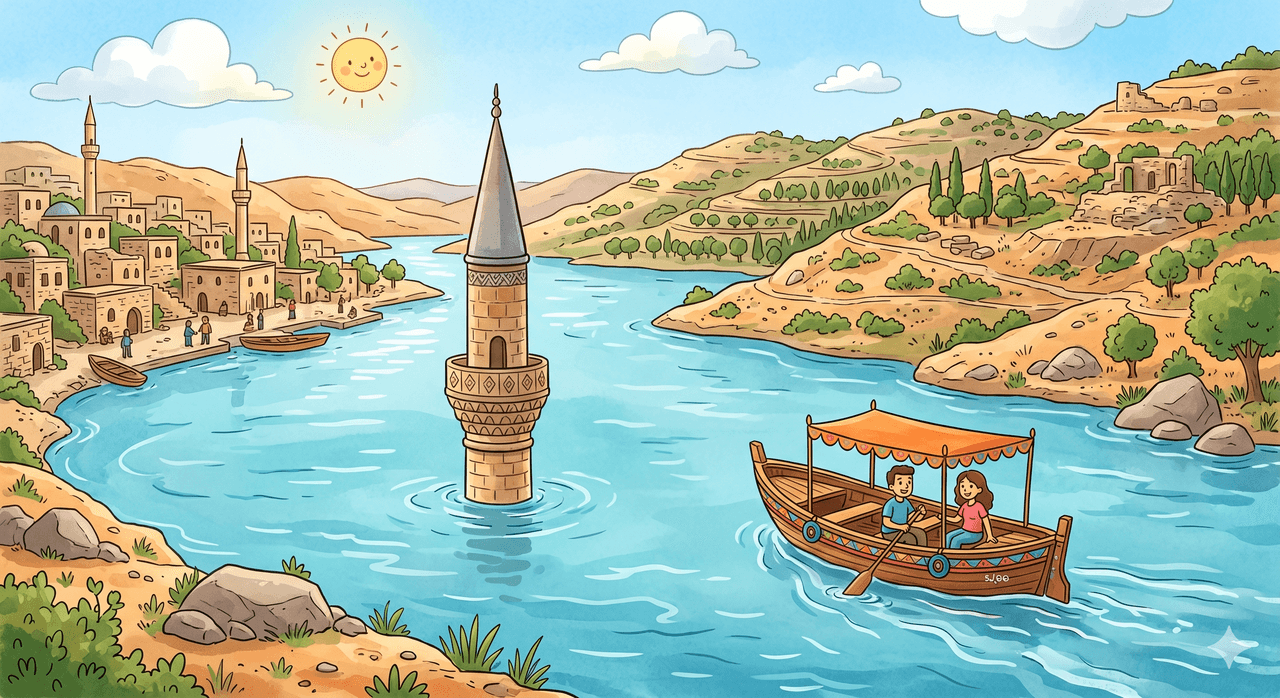
Halfeti’s Unique Landscape (Generated by Artificial Intelligence)
What Does “Slow City” Mean?
Have you ever heard of a “Slow City” or Cittaslow? In 2013, Halfeti was selected as one of Türkiye’s few designated Slow Cities. Slow Cities are special towns that preserve their natural environment local cuisine and historical beauty rather than pursuing rapid and overcrowded growth.
The emblem of Slow Cities is a snail carrying colorful houses on its back. The snail reminds us to move forward wisely, savoring life and avoiding harm to our surroundings.

Slow City Emblem (Generated by Artificial Intelligence)
What Interesting Plants Grow in Halfeti?
Halfeti’s greatest secret lies in its soil. Here grows the world-famous “Karagül” or Black Rose. This rose is actually a deep red but blooms jet black in Halfeti. If you take its seeds and plant them in another city, the color changes — it remains black only in Halfeti’s soil.
Additionally, a rare flower known as the “Mesopotamia Iris” thrives in this region. The district’s fertile land supports abundant pistachio cultivation, and only here, in these rivers, lives a unique fish called “Şabut.”
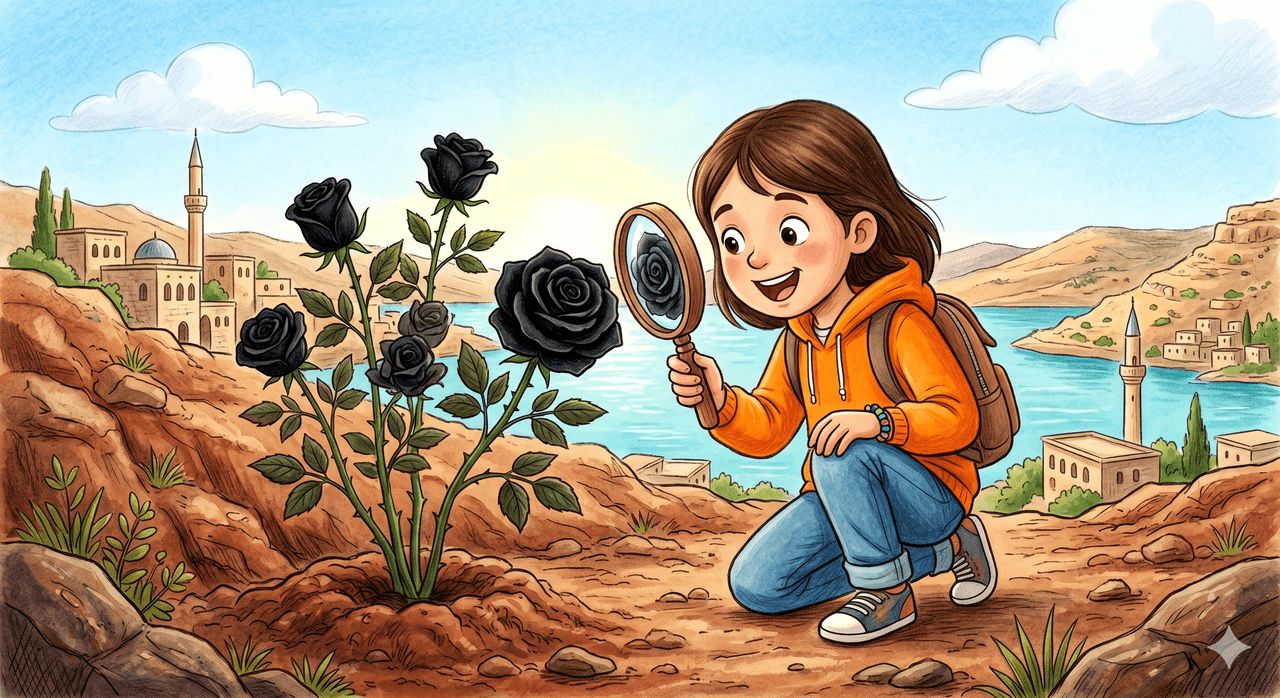
Karagül (Generated by Artificial Intelligence)
Time Travel
Halfeti has been home to many civilizations since ancient times. In 855 BCE the Assyrians named it “Şitamrat.” Over the centuries the Romans called it “Romaion Koyla,” and the Ottomans referred to it as “Urumgala” or Rumkale. Today the ancient Rumkale on the banks of the Fırat Nehri can still be seen.【1】
Citations
[1]
Ayşegül Bulut and Şenol Adıgüzel, “Türkiye’den Bir Sakin Kent Örneği: Halfeti / An Example of Slow City from Türkiye: Halfeti,” Ardahan Üniversitesi İktisadi ve İdari Bilimler Fakültesi Dergisi 6, no. 1 (2024): 48–56, accessed 1 May 2026, https://dergipark.org.tr/tr/pub/aruiibfdergisi